Procurement Strategy
The 'Amortization Cliff': Why 500 Custom Notebooks Cost the Same as 1,000
Understanding the math of fixed costs: why 'saving money' by reducing quantity often yields zero actual savings.
By Robert Chen, Senior Procurement Consultant ·
One of the most counter-intuitive conversations in procurement happens when a client asks to cut their order from 1,000 units to 500 to "save budget," and we have to explain that the total invoice will remain almost exactly the same.
The Fixed Cost Trap
In custom manufacturing, your "Unit Price" is a lie. It is actually a composite of two very different numbers: Variable Costs (materials, labor) and Fixed Costs (molds, plates, setup, calibration).
For a custom debossed leather notebook, the Fixed Costs are heavy:
- Brass Debossing Mold: $150
- Custom Pantone Dye Setup: $300
- Machine Calibration (2 hours): $200
- Total Fixed Cost: $650
This $650 must be paid whether you make 1 notebook or 10,000. It is the "entry fee" to the factory floor.
The Math of the Cliff
Let's look at the Variable Cost per notebook (paper, leather, glue, labor): $3.00.
| Quantity | Fixed Cost Share | Variable Cost | Unit Price | Total Invoice |
|---|---|---|---|---|
| 500 | $1.30 ($650/500) | $3.00 | $4.30 | $2,150 |
| 1,000 | $0.65 ($650/1000) | $3.00 | $3.65 | $3,650 |
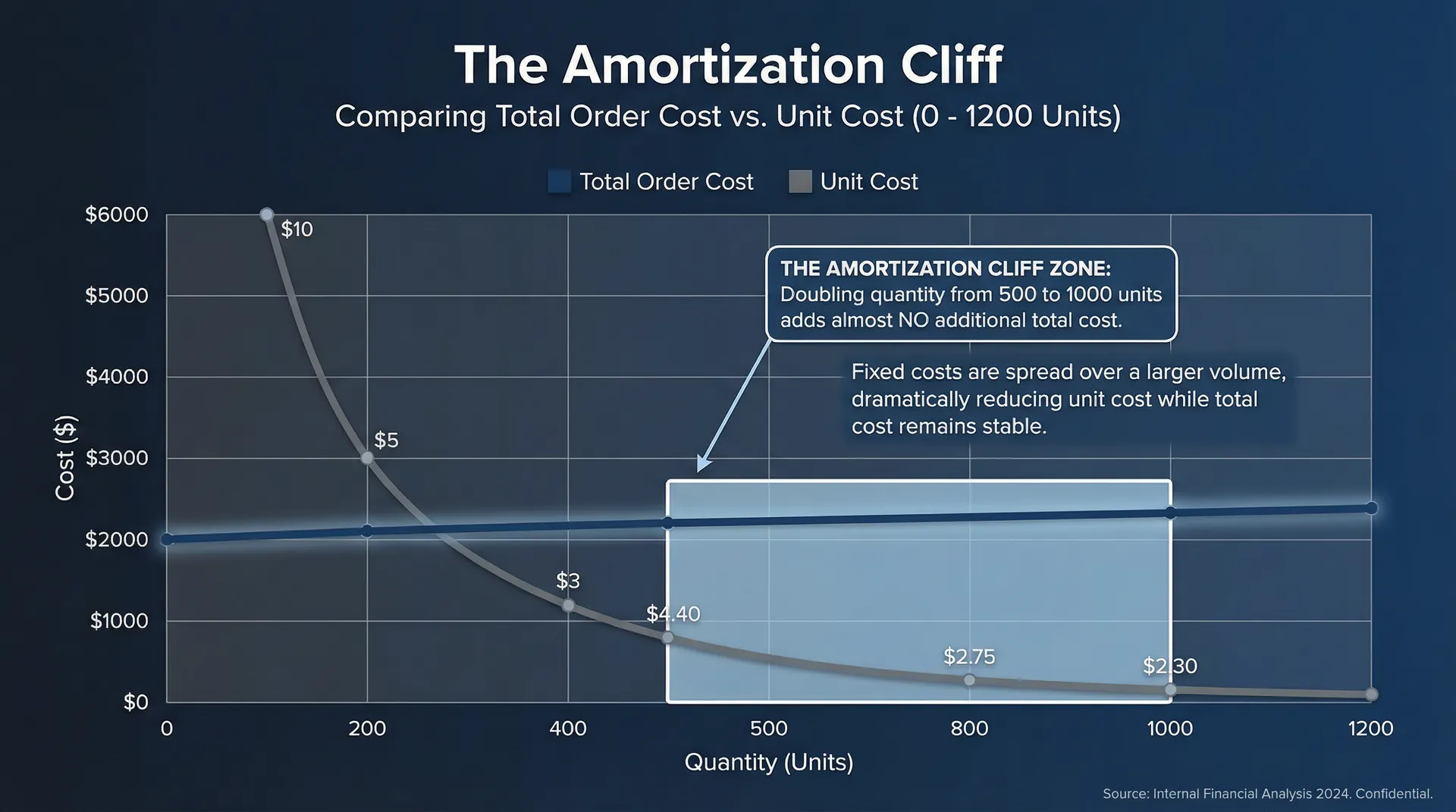
While the total invoice does go up, it doesn't double. You get double the inventory for only a 70% price increase. Conversely, cutting the order in half only saves you 40% of the budget, but spikes your unit cost by 18%.
Strategic Implications
In practice, this is often where MOQ decisions start to be misjudged. Buyers focus on the "Total Line Item" without realizing they are standing on the edge of an amortization cliff.
If you are near the 500-unit mark, we almost always advise pushing to 1,000. The "extra" 500 units cost you very little (just the variable $3.00), effectively giving you a 50% discount on the second half of your order. You can use this excess inventory for unexpected new hires, client gifts, or event swag throughout the year.