Compliance & Risk
The 'Chain of Custody' Cost: Why Certified Sustainable Materials Spike MOQs
Why requesting FSC or GRS certification forces factories to stop production lines, driving up minimum order requirements.
By Elena Rodriguez, Quality & Compliance Consultant ·
A common scenario in modern procurement: A brand decides to switch their standard notebook order to "FSC Certified Paper" to meet ESG goals. They expect a small price increase. Instead, they are hit with a doubled Minimum Order Quantity (MOQ). Why does a certificate change the volume requirement?
The "Line Clearance" Protocol
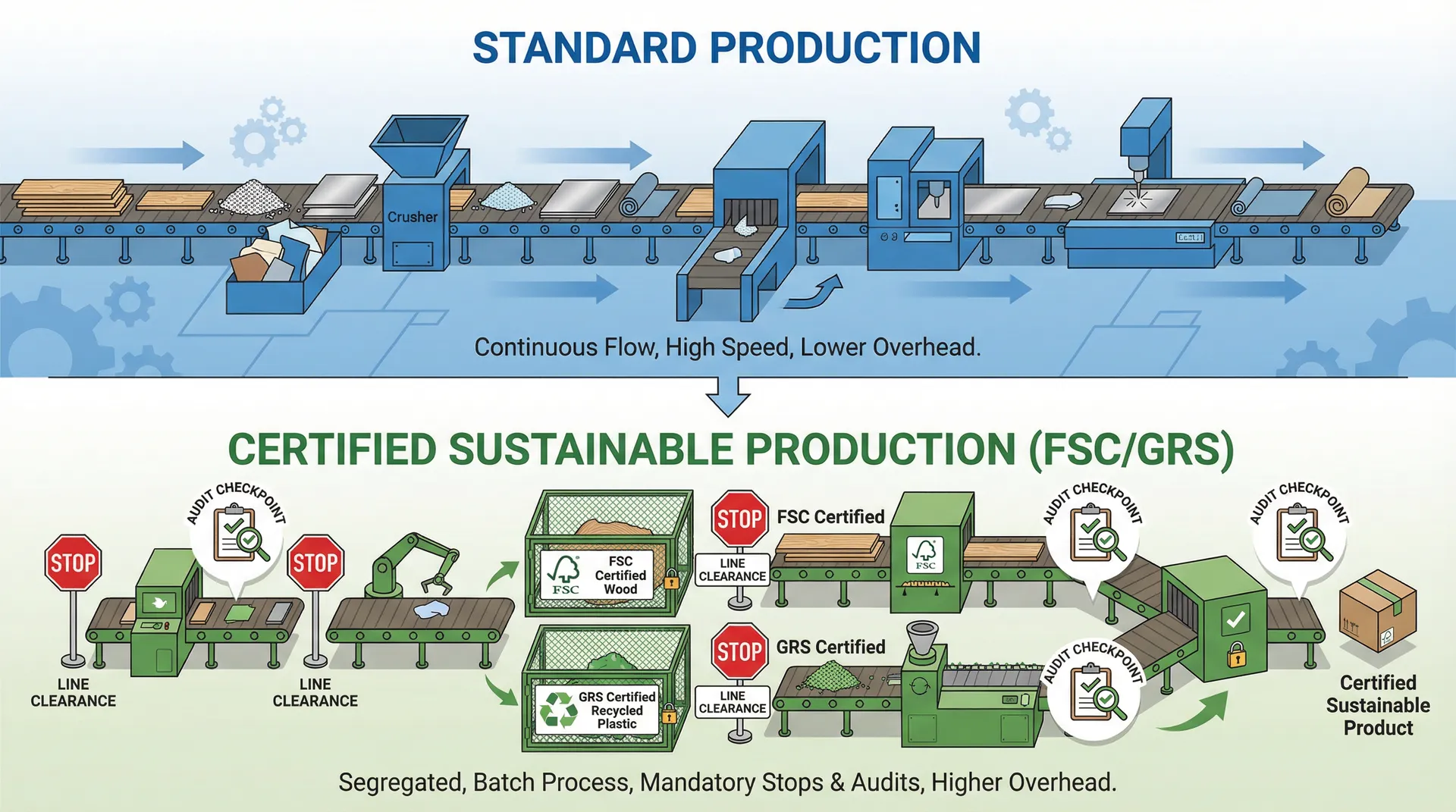
To a compliance auditor, "Certified" means "Segregated." We cannot process FSC-certified wood pulp on the same machine as standard pulp without a rigorous cleaning process in between. This is called Line Clearance.
Before we can run your certified order, we must:
- Stop the high-speed production line.
- Purge all non-certified material from the rollers, hoppers, and cutting blades.
- Document the "clean state" for the audit trail.
- Run your certified batch.
- Stop and purge again before returning to standard production.
Audit Trails Are Not Free
In standard production, efficiency comes from continuity. We run the same white paper for weeks. In certified production, efficiency is sacrificed for traceability. Every minute the machine is stopped for Line Clearance is lost revenue.
To recover the cost of this downtime, the factory must amortize it over a larger number of units. This is why the MOQ for FSC paper might be 5,000 units while standard paper is 1,000. You are not just paying for the paper; you are paying for the machine downtime required to prove it is the right paper.
The "Mixed Credit" Alternative
If the strict "100% Certified" MOQ is prohibitive, ask about "FSC Mix" or "Mass Balance" options. These certifications often allow for more flexible production methods that don't require total line segregation, potentially lowering the volume threshold.
Compliance Reality Check
Sustainability is not just a material choice; it is a process choice. When you demand certification, you are demanding a segregated supply chain. Understanding this helps you evaluate whether the MOQ trade-offs are worth the compliance value for your specific project.
In practice, this is often where sustainable sourcing decisions start to be misjudged—teams budget for the material premium but fail to budget for the operational premium of segregation.