Quality & Compliance
The 'Compliance Tax': Why Lab Testing Destroys Small-Batch Unit Economics
How flat-fee safety testing (Prop 65, REACH) creates a hidden 'tax' that makes small orders financially unviable.
By Sarah Jenkins, Quality & Compliance Consultant ·
In the world of custom manufacturing, safety isn't free. It comes with a price tag attached to a lab report. For large corporations, this is a rounding error. For small brands, it's often the silent killer of profitability.
The Flat-Fee Reality of Safety
Whether you order 500 notebooks or 50,000, the cost to test the ink for lead (Prop 65) or the paper for formaldehyde (REACH) is exactly the same. The lab doesn't care about your order volume; they care about the number of chemical tests required.
A standard "full battery" safety test for a custom journal—covering cover material, paper, ink, and glue—can easily cost $500 to $800 per SKU. This is a fixed cost that must be amortized across your entire production run.
The Unit Economics "Death Spiral"
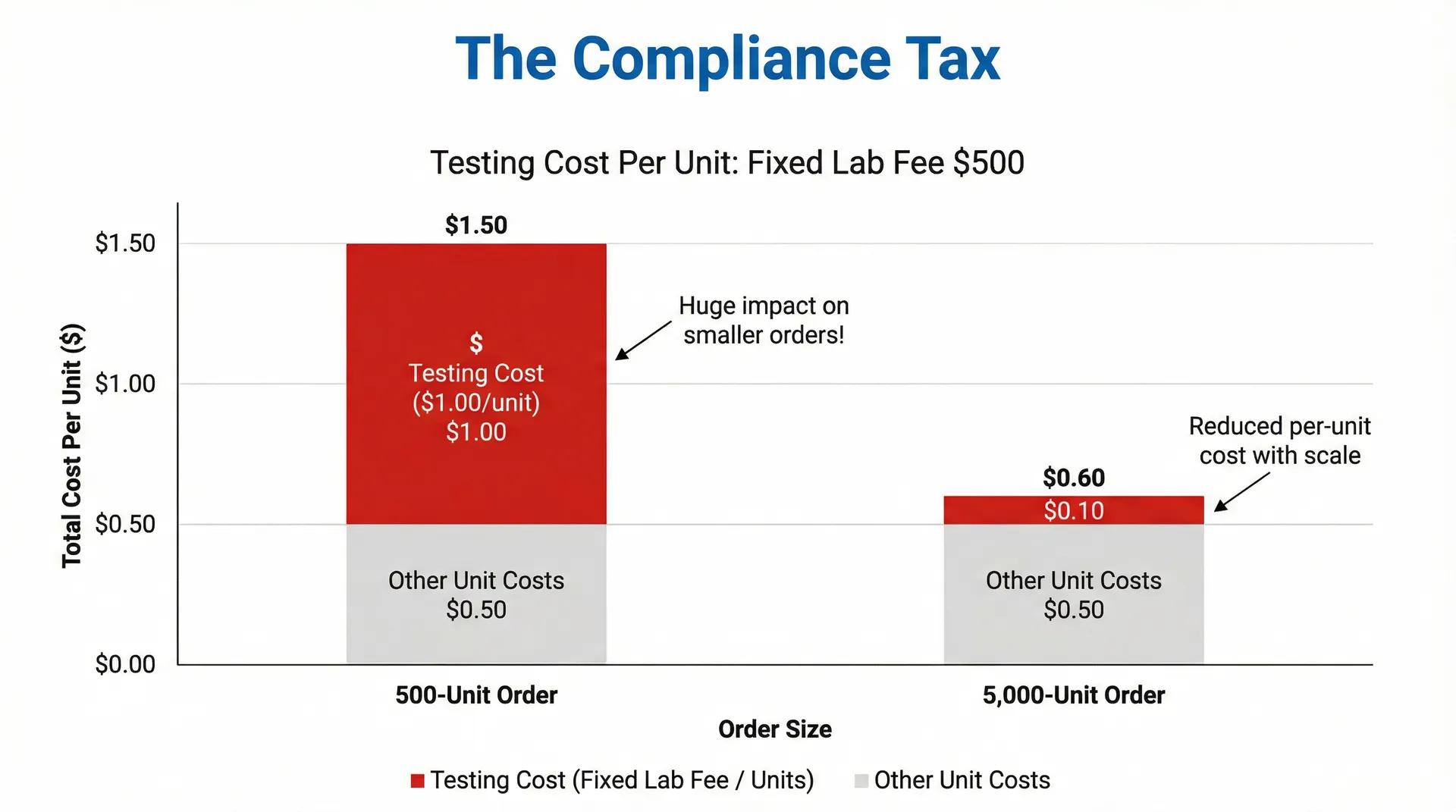
This fixed cost creates what we call the "Compliance Tax." Let's look at how a $500 lab fee impacts the unit cost of a notebook:
| Order Quantity | Lab Test Fee (Fixed) | Compliance Cost Per Unit | Impact on Margin |
|---|---|---|---|
| 500 | $500 | $1.00 / unit | DEVASTATING |
| 2,500 | $500 | $0.20 / unit | MANAGEABLE |
| 5,000 | $500 | $0.10 / unit | NEGLIGIBLE |
For a small run of 500 units, you are effectively paying a $1.00 "tax" on every single notebook just to prove it's safe. In a competitive market where margins are thin, that dollar can be the difference between profit and loss.
The "Waiver" Trap
In practice, this is often where MOQ decisions start to be misjudged. Brands will ask, "Can we just skip the test?"
As a compliance consultant, my answer is always no. Retailers like Target or Walmart will demand these reports before your product even hits the shelf. Customs agents can seize shipments that lack proper documentation. The risk of a recall or lawsuit far outweighs the cost of the test.
The only real solution is volume. By increasing your order size, you dilute the compliance tax until it becomes invisible. This is why "low MOQ" often comes with a "high unit price" caveat—it's not just the factory being greedy; it's the math of compliance.