Production Strategy
The 'Component Bottleneck': Why Custom Hardware Dictates Finished Good MOQs
Understanding the 'Weakest Link' rule in manufacturing: how a single custom zipper pull can force your entire bag order from 500 to 5,000 units.
By Michael Chen, Factory Project Manager ·
A client recently asked us to produce 500 custom laptop bags. The fabric MOQ was fine. The labor was fine. But the quote came back with a 5,000-unit minimum. The culprit? A custom-molded metal zipper pull.
The "Weakest Link" Rule
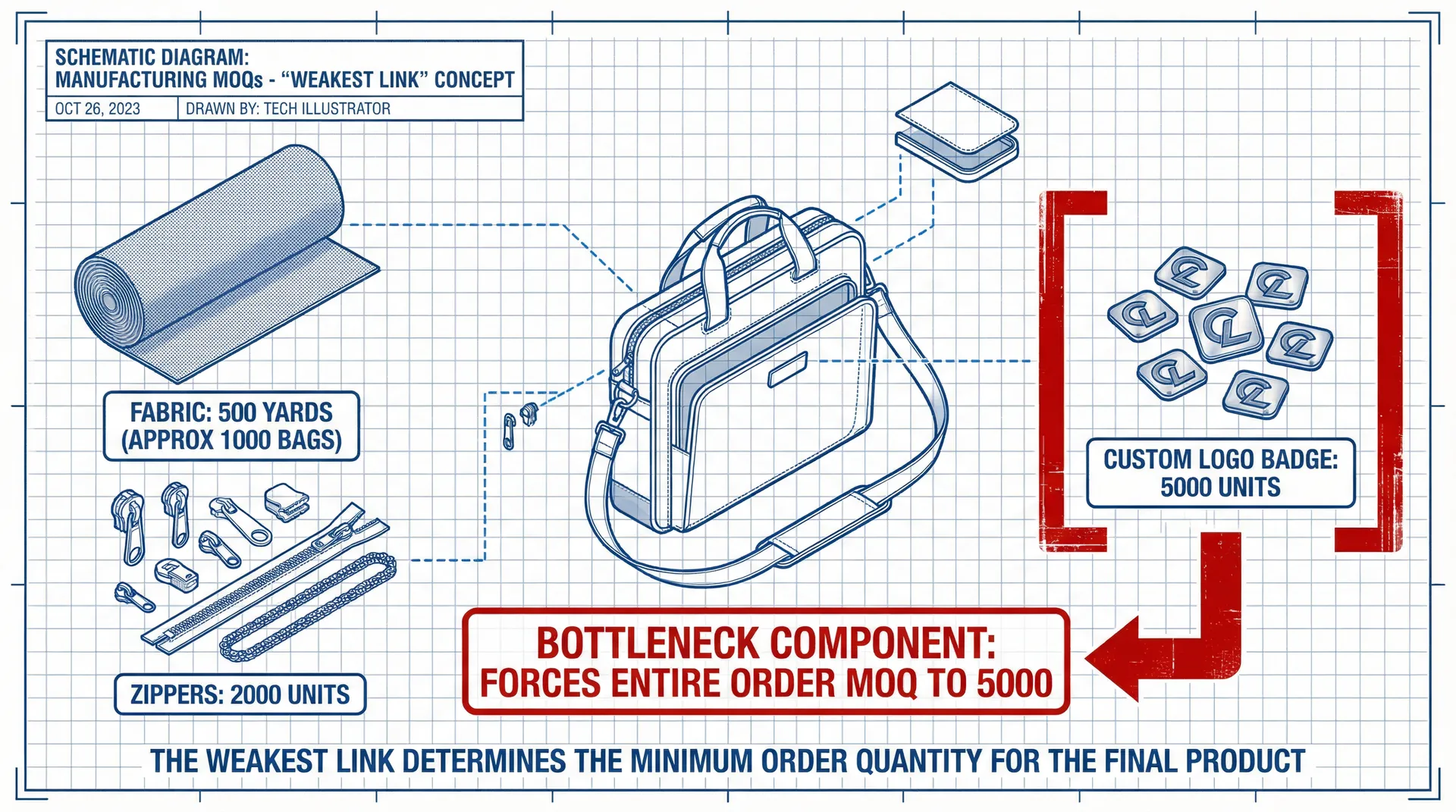
In assembly manufacturing, the Minimum Order Quantity of the finished good is always equal to the highest MOQ of its constituent parts. We call this the Component Bottleneck.
Consider a standard corporate backpack. It is made of:
- Nylon Fabric: MOQ 500 yards (enough for ~1,000 bags)
- Webbing Straps: MOQ 1,000 yards (enough for ~500 bags)
- Custom Metal Badge: MOQ 5,000 units (mold requirement)
Because we cannot buy 500 metal badges—the metal factory will only turn on their die-casting machine for 5,000—we are forced to either buy 5,000 badges and throw 4,500 away (amortizing the cost), or require you to buy 5,000 bags.
Strategic Workarounds
When a single component is driving your volume requirement up, you have three options:
- Switch to Stock: Use a standard zipper pull available in the market. This drops the bottleneck instantly.
- Pre-Buy Components: Pay for the 5,000 badges upfront, use 500 now, and warehouse the remaining 4,500 for future orders. This is often the smartest financial move for long-term programs.
- Amortize the Waste: Pay the full cost of the 5,000 run but only take delivery of 500. This spikes the unit price significantly but keeps the total inventory low.
Design for Manufacturing
The most effective way to lower your overall MOQ is to identify these bottlenecks during the design phase. Ask your factory: "Which specific part of this design is driving the volume requirement?"
In practice, this is often where custom hardware decisions start to be misjudged—designers treat a zipper pull as a detail, while the factory sees it as the defining constraint of the entire production run.