Production Economics
The 'Dead Stock' Liability: Why You Pay for the Whole Fabric Roll
Why factories charge for unused material when your order size doesn't match the standard roll length, and how to optimize your quantity to avoid this hidden cost.
By Sarah Jenkins, Factory Project Manager ·
One of the most contentious line items on a factory invoice is the "Material Surcharge" or "Dead Stock Fee." Clients often assume we are buying fabric by the yard, just like they would at a retail store. In industrial manufacturing, that is simply not how the supply chain works.
The "Roll Minimum" Constraint
We purchase raw materials—whether it's PU leather for notebooks or canvas for pencil pouches—in master rolls. These rolls typically come in fixed lengths, often 500 yards or 1,000 meters depending on the supplier. Our material suppliers do not cut these rolls. We must buy the whole roll, or nothing at all.
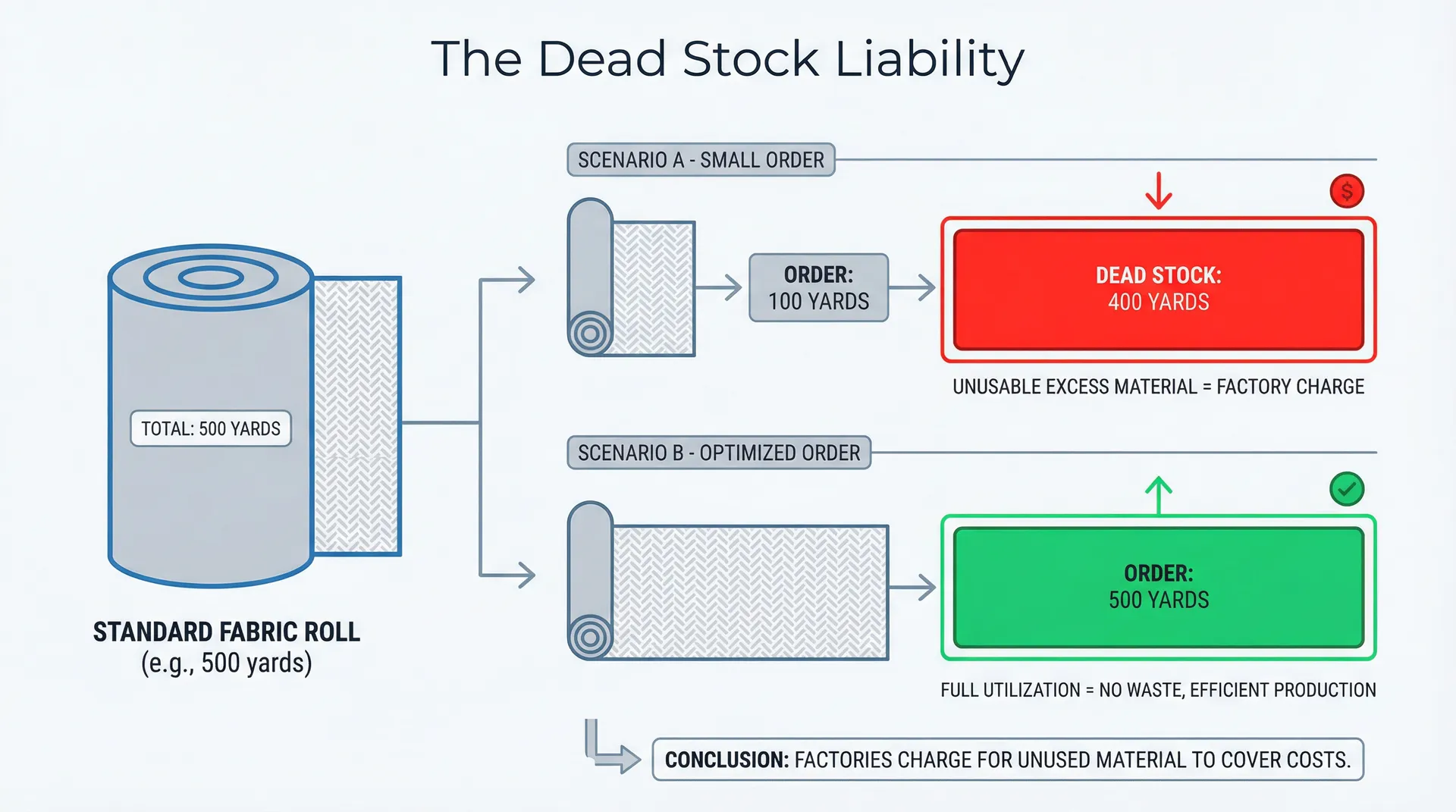
This creates a binary constraint: if your order requires 100 yards of a specific custom color, we still have to buy the 500-yard roll. The remaining 400 yards is what we call "Dead Stock."
Who Pays for the Waste?
This dead stock is a liability. It takes up warehouse space, it degrades over time, and the chances of another client wanting that exact specific shade of Pantone 289C are statistically near zero. Therefore, the cost of the entire roll must be amortized into your small order.
| Scenario | Material Needed | Material Purchased | Wasted Material | Who Pays? |
|---|---|---|---|---|
| Small Order (500 units) | 100 Yards | 500 Yards | 400 Yards (80%) | Client (Surcharge) |
| Optimized Order (2,500 units) | 500 Yards | 500 Yards | 0 Yards (0%) | None (Efficient) |
In the small order scenario, you are effectively paying for 500% more material than you are actually using. This is why the unit price for small batches seems disproportionately high—it includes the cost of the trash bin.
The "Stock Color" Exception
The only way to bypass this rule is to choose a "Stock Color." These are materials we buy in massive bulk (10,000+ yards) because they are common—Black, Navy, Grey. For these, we can slice off just what you need because we know the rest will be used by the next client.
But the moment you demand a custom brand color, you trigger the roll minimum. In practice, this is often where MOQ decisions start to be misjudged. Marketing teams demand exact color matching, not realizing that this aesthetic choice forces the procurement team to pay for hundreds of yards of waste.
The solution? Either increase your order quantity to consume the full roll, or accept a standard stock color to avoid the liability entirely.