Logistics & Supply Chain
The '1 CBM' Rule: Why Shipping Small Batches Doubles Your Landed Cost
Understanding the logistics 'floor': why sea freight forwarders charge a minimum of 1 Cubic Meter, meaning you pay for empty air when shipping small volumes.
By Michael Chen, Senior Procurement Consultant ·
There is a hidden floor in international logistics that catches almost every first-time importer off guard. It's not a tariff, and it's not a tax. It's a simple rule of physics and economics enforced by every freight forwarder on the planet: the 1 CBM minimum.
The "Empty Air" Penalty
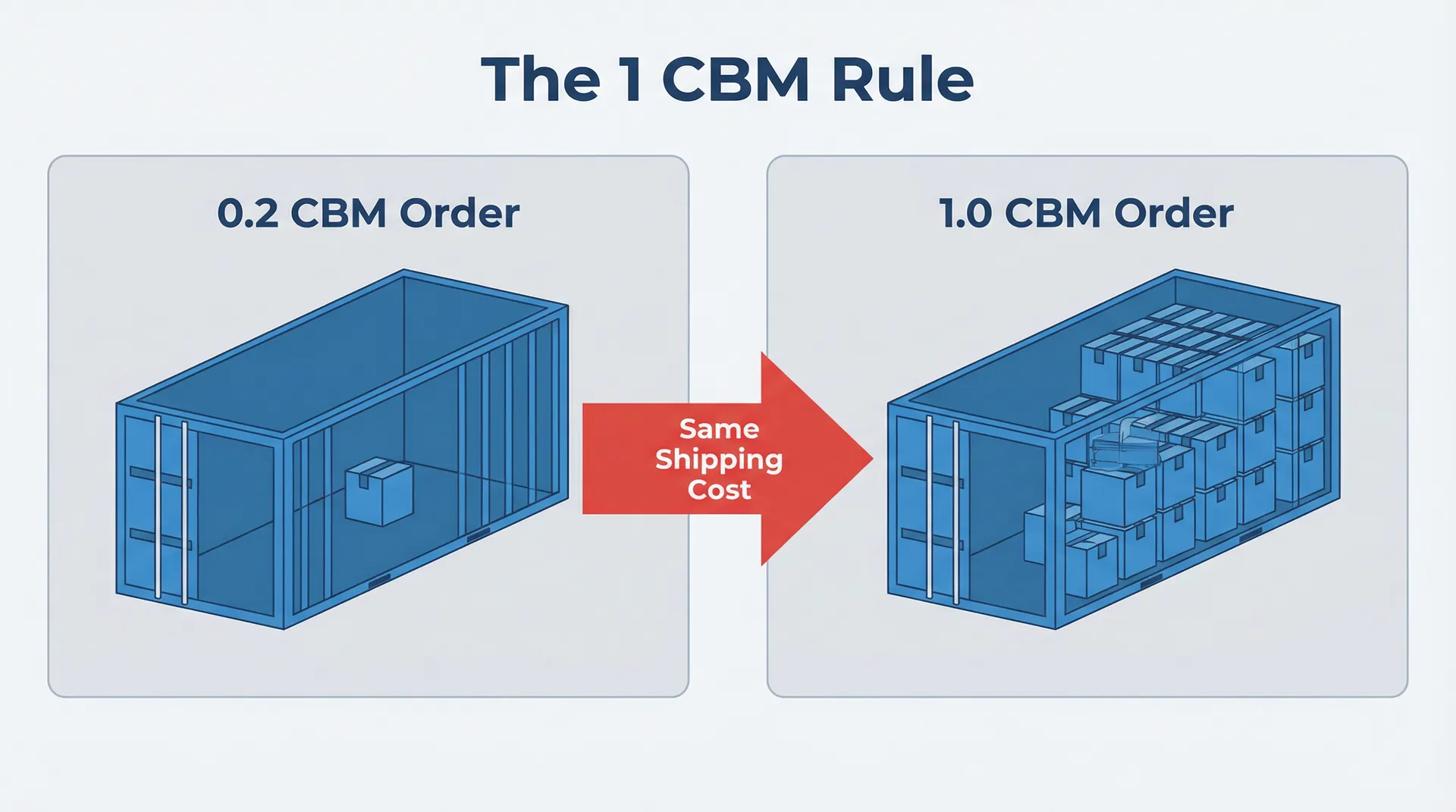
When you ship goods via LCL (Less than Container Load), you are renting space in a shared container. Logic suggests that if you ship half a cubic meter of goods, you should pay for half a cubic meter of space. In practice, this is false.
Freight forwarders and consolidators have a strict minimum billing volume of 1 Cubic Meter (CBM). Whether your shipment is 0.1 CBM or 0.9 CBM, you will be billed for the full 1.0 CBM. This means that for small orders, you are literally paying to ship empty air.
The Math of Inefficiency
Let's look at how this impacts the "Landed Cost" (the total price of the product once it arrives at your door) for a standard order of custom notebooks.
| Order Volume | Actual Volume | Billed Volume | Freight Cost ($200/CBM) | Freight Cost Per Unit |
|---|---|---|---|---|
| 500 Notebooks | 0.2 CBM | 1.0 CBM | $200 | $0.40 / unit |
| 2,500 Notebooks | 1.0 CBM | 1.0 CBM | $200 | $0.08 / unit |
By ordering only 500 units, your freight cost per unit is 500% higher than if you ordered the volume that actually fits the minimum billing unit. You are subsidizing the logistics company's efficiency.
The Strategic Pivot
In practice, this is often where MOQ decisions start to be misjudged. Buyers focus intensely on the factory price (FOB) while ignoring the landed cost.
If your factory quote is $2.00 per unit, but your inefficient shipping adds $0.40, your real cost is $2.40. Often, increasing your order quantity to hit that 1 CBM sweet spot will lower your landed cost enough to justify the extra inventory holding costs.
The smartest procurement strategy isn't just about negotiating the product price; it's about designing your order volume to fit the logistics container, not the other way around.