Production Science
The Physics of Dye Lots: Why Custom Pantone Leather Requires High MOQs
A factory-floor explanation of why 'just 50 notebooks' in a custom color is physically impossible without massive waste.
By James Wu, Factory Project Manager ·
One of the most frequent friction points I see between US procurement teams and our production floor is the request for "just 100 notebooks in our specific brand blue." To a marketing director, this seems like a simple print job. To a factory manager, it is a request to defy the physics of liquid dynamics.
The "Vat Capacity" Constraint
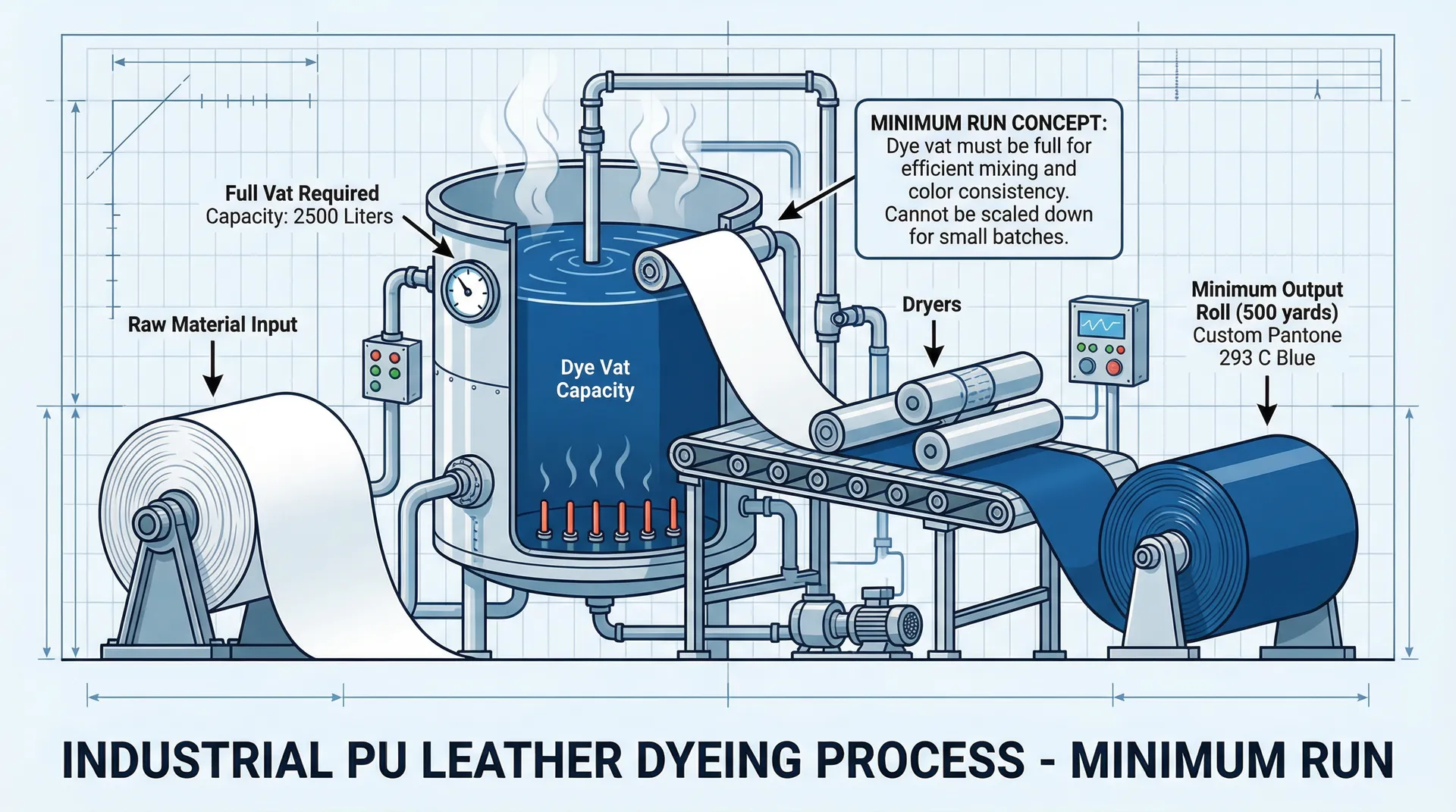
PU (Polyurethane) leather is not printed; it is dyed. The raw material starts as a massive roll of white base fabric. To turn it blue, we must submerge it in a heated dye vat. These vats are industrial-sized vessels designed to hold 2,500 liters of liquid dye mixture at a stable temperature.
Here is the critical constraint: The vat must be full to function.
If we only fill the vat 10% full (to dye material for 100 notebooks), the impeller blades cannot circulate the dye. The temperature sensors—located midway up the tank—will read air instead of liquid, causing the heating elements to overheat and burn the dye. To run the machine, we must mix enough dye for a full run.
The Mathematics of Waste
A standard industrial dye vat processes enough material for roughly 1,000 yards of PU leather in one cycle. This yields about 3,000 notebook covers.
If you insist on ordering only 500 notebooks in a custom Pantone 293 C, we still have to mix the full 2,500 liters of dye and run the full length of material to maintain tension in the rollers. We would effectively produce 3,000 covers, cut out the 500 you ordered, and throw the remaining 2,500 into the landfill. The cost of that waste is why the "Less Than Minimum" fee for custom colors is often equal to the cost of the full order.
Why "Stock" is the Only Low-MOQ Option
This is why we constantly steer low-volume projects toward "stock colors." Stock colors (Navy, Black, Grey) are run continuously. We are dyeing 50,000 yards of Navy Blue every month. When you order 100 Navy notebooks, we are simply slicing a tiny piece off a river of material that is already flowing. Custom colors require building a new dam.
Strategic Implication
Understanding this physical constraint helps you make better procurement decisions. If your brand color is non-negotiable, you must accept the Minimum Order Quantity realities of industrial manufacturing.
In practice, this is often where custom color decisions start to be misjudged—procurement teams assume it's a "setup fee" issue, when in reality, it is a raw material volume issue.