Production Engineering
The 'Setup Scrap' Ratio: Why Complex Finishes Spike MOQs
Explaining the 'Make-Ready' phenomenon: why foil stamping and edge painting require sacrificing inventory to calibrate machines.
By David Miller, Factory Production Manager ·
When a client asks for "just 50 notebooks with gold foil stamping," they assume the machine works like an office printer: press a button, get a print. In reality, industrial finishing machines are beasts that need to be "fed" waste before they produce quality.
The "Make-Ready" Reality
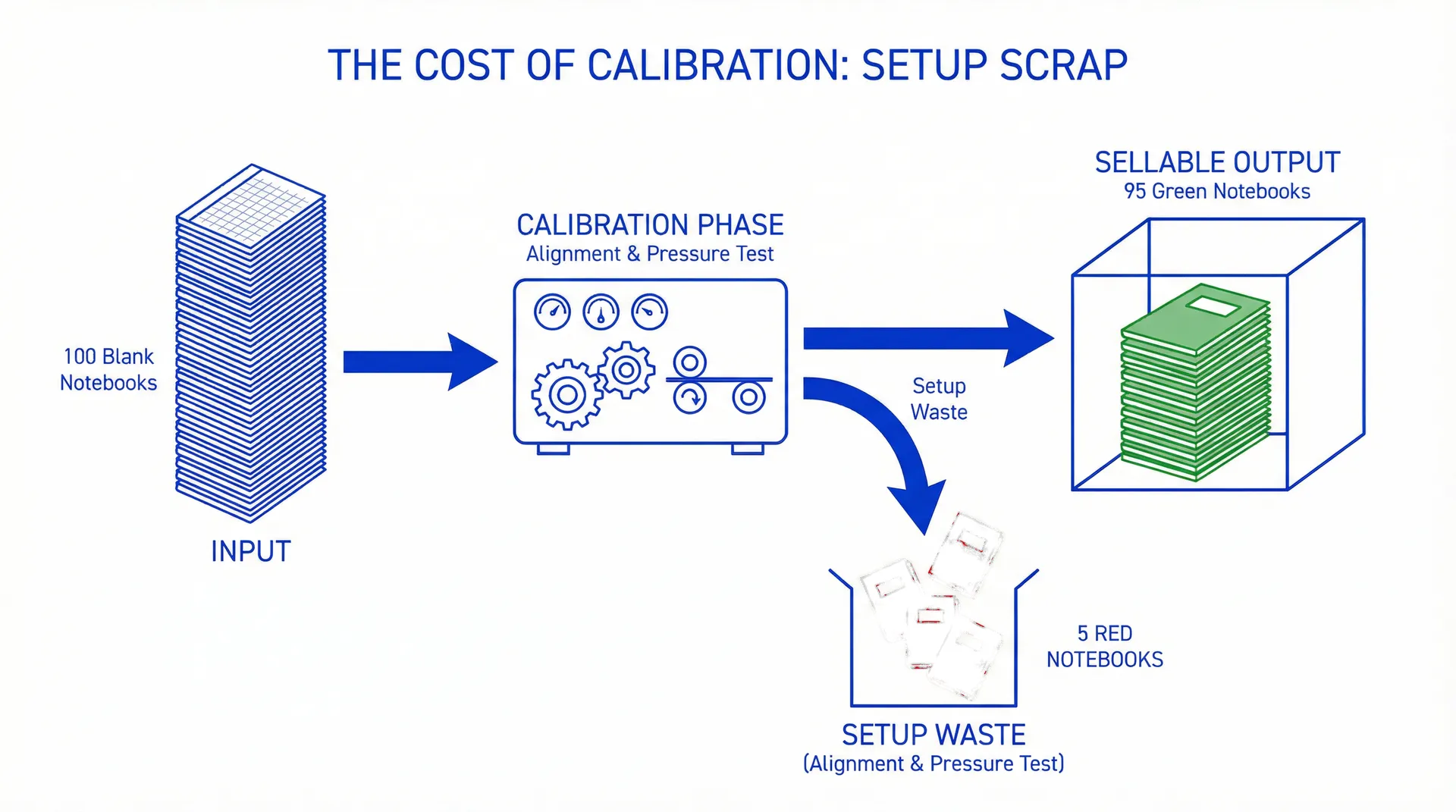
Every time we set up a hot foil stamping press or an edge-painting machine, we have to perform a process called "Make-Ready." This involves aligning the die, adjusting the heat, calibrating the pressure, and testing the registration.
Crucially, we cannot calibrate the machine using empty air. We have to run actual product through it. For a standard foil stamping job, we might destroy 30 to 50 notebook covers just to get the foil to stick perfectly and the alignment to be dead-center.
The Scrap Ratio Calculation
This fixed "setup scrap" creates a brutal mathematical floor for MOQs. Let's look at the numbers for a complex edge-painting job that requires 40 units of calibration waste:
| Order Quantity | Setup Waste (Fixed) | Total Materials Needed | Waste Percentage | Factory Verdict |
|---|---|---|---|---|
| 100 | 40 units | 140 units | 28.5% | REJECTED |
| 500 | 40 units | 540 units | 7.4% | NEGOTIABLE |
| 1,000 | 40 units | 1,040 units | 3.8% | ACCEPTED |
For a 100-unit order, we would be throwing away nearly 30% of the expensive raw materials just to set up the machine. No factory can sustain that level of waste and remain profitable (or environmentally responsible).
Why "Paying Extra" Doesn't Help
Clients often offer to "pay for the waste." But in practice, this is often where MOQ decisions start to be misjudged. It's not just about the cost of the scrapped material; it's about the opportunity cost of the machine time.
Stopping a high-speed production line to run a 100-unit job (which takes just as long to set up as a 5,000-unit job) kills our efficiency rating. If you want complex finishes like foil, spot UV, or edge painting, you must respect the physics of the machine: it needs volume to run clean.