Procurement Strategy
The 'Split Shipment' Fallacy: Why Warehousing Logic Doesn't Solve Production MOQs
Why asking for staggered deliveries fails to address the fundamental production constraints of Minimum Order Quantities.
By Sarah Jenkins, Senior Procurement Consultant ·
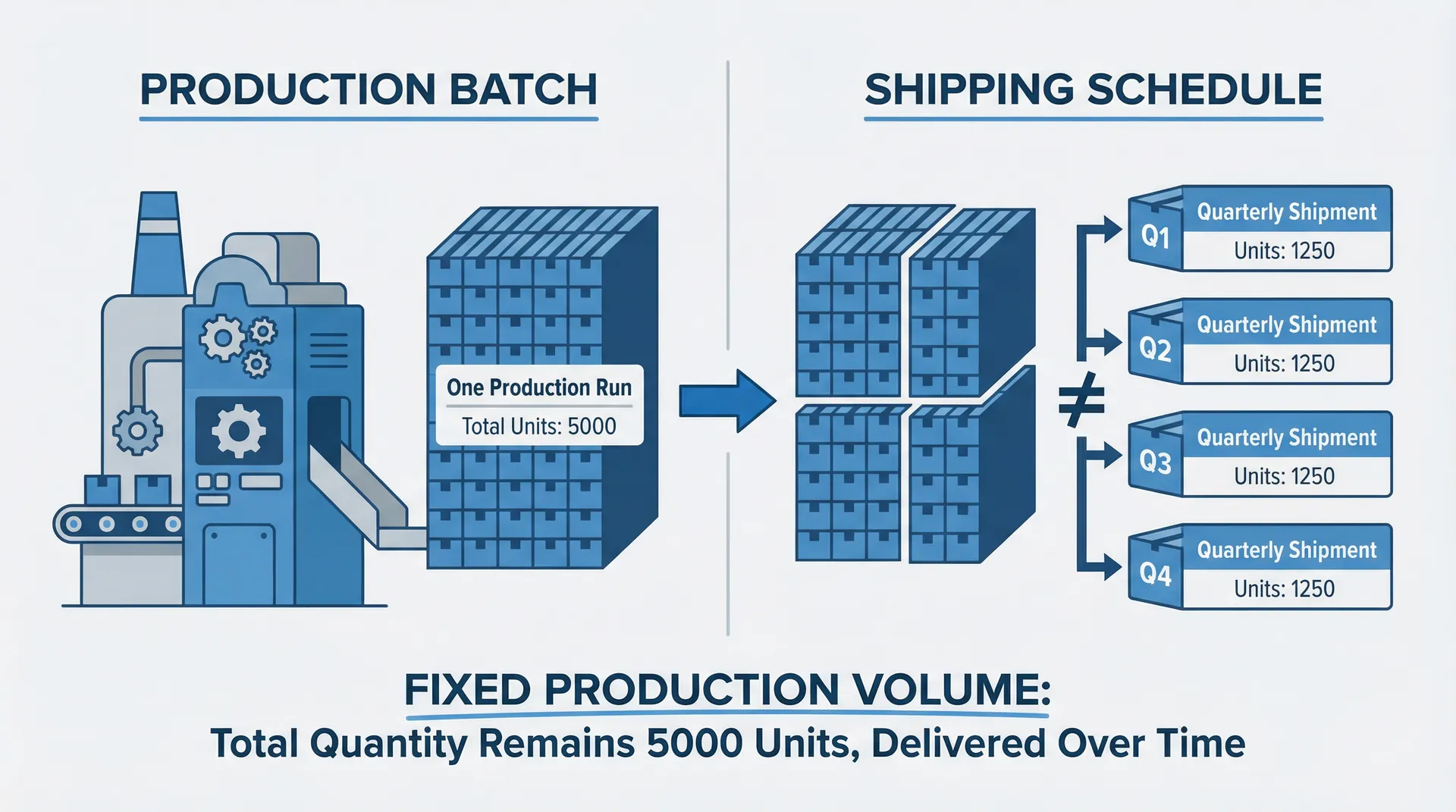
In my fifteen years consulting for Fortune 500 procurement teams, I have seen one negotiation tactic fail more consistently than any other. It happens when a buyer, facing a 5,000-unit MOQ for a custom notebook, asks: "Can we just split that into four quarterly shipments of 1,250 units?"
The Production vs. Distribution Disconnect
This request reveals a fundamental misunderstanding of what an MOQ actually represents. To a procurement manager, 5,000 units is a supply chain number—a volume of goods moving from Point A to Point B. But to a manufacturer, 5,000 units is a production event.
The factory does not turn the machines on four separate times to make 1,250 units. The setup costs, material calibration, and line stoppage fees would quadruple, destroying the unit economics. To meet the price point you negotiated, the factory must produce all 5,000 units in a single continuous run.
Factories Are Not Warehouses
When you ask for split shipments to "meet the MOQ," you are effectively asking the factory to act as your free warehouse. You are asking them to:
- Front the cash for raw materials for the full year.
- Occupy valuable floor space with your finished goods for 9 months.
- Assume the risk of damage or humidity spoilage during storage.
In practice, this is often where split shipment decisions start to be misjudged. The factory rejects the deal not because they can't ship four times, but because they cannot finance your inventory.
The "Bill & Hold" Solution
If you truly cannot accept 5,000 units at once due to space constraints, the correct approach is a "Bill & Hold" agreement. You pay for the full production run upfront (satisfying the factory's capital requirements), and then pay a separate monthly fee for warehousing and fulfillment.
Strategic Takeaway
Do not conflate shipping schedules with production minimums. If you need to lower the actual production volume, you must revisit the core drivers of MOQ, such as material choices or customization depth, rather than logistics.