Logistics Strategy
The 'Binary' Lead Time: Why Averages Fail in Customs Clearance
Why using a '3-day average' for customs clearance in your ERP system is a statistical trap, and how to plan for the binary reality of 'Green Lane' vs. 'Intensive Exam'.
By StationeryWorks Editorial Team, Senior Corporate Procurement Consultant ·
In the orderly world of Enterprise Resource Planning (ERP) systems, every variable is reduced to a single number. When a procurement manager inputs the lead time for "Customs Clearance," they typically use a historical average—often 3 to 5 days. This number is comforting. It fits neatly into Gantt charts and allows for precise delivery projections. Unfortunately, in the chaotic reality of international logistics, this average is a fiction that actively endangers supply chain reliability.
As a consultant advising Fortune 500 procurement teams, I frequently have to deconstruct this "Average Fallacy." The problem is that customs clearance is not a bell curve distribution where most shipments take 3 days, some take 2, and some take 4. It is a binary distribution. Your shipment will either flow through the automated "Green Lane" in 48 hours, or it will be flagged for an "Intensive Exam" (CES) and sit in a bonded warehouse for 15 days. There is almost no scenario where a shipment takes the "average" of 5 days.
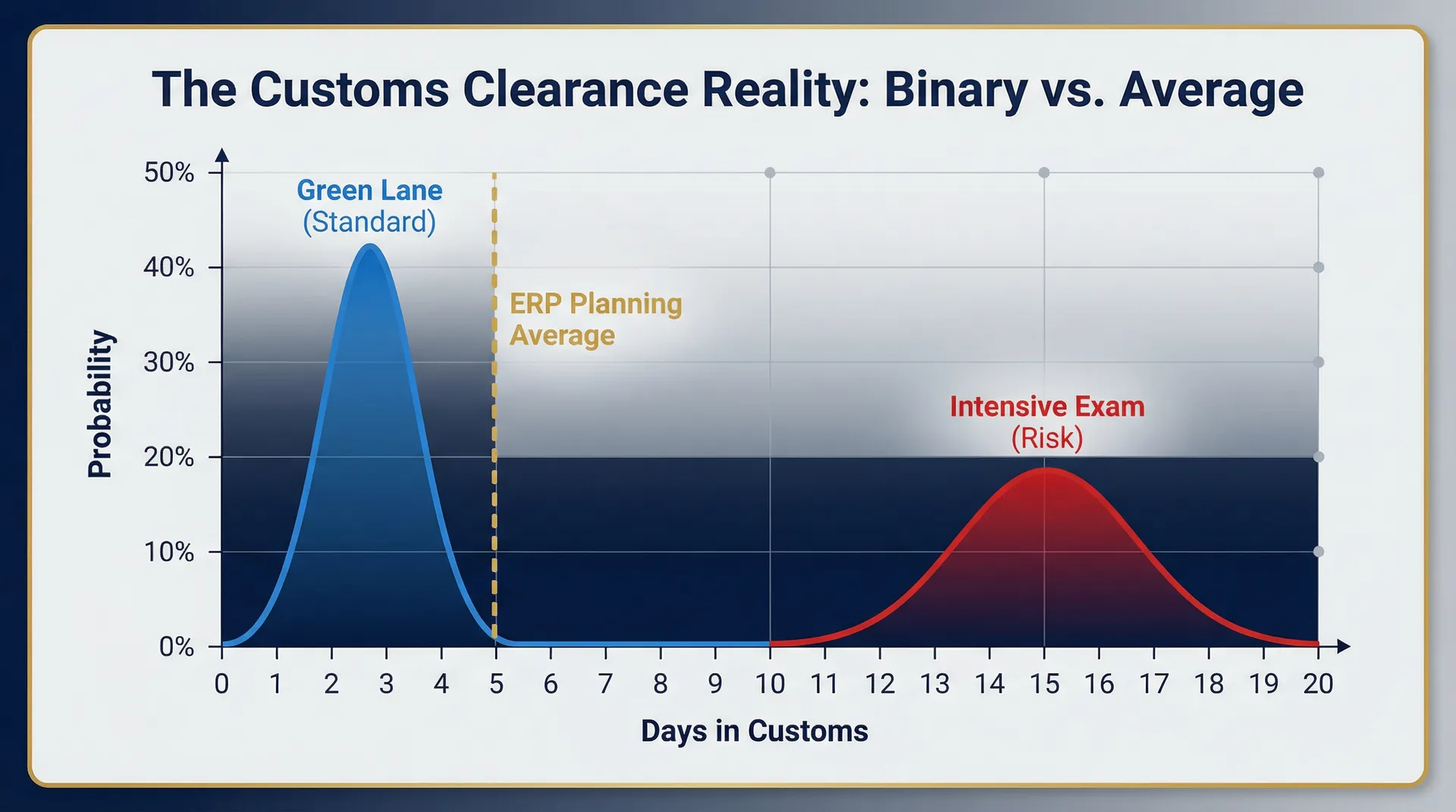
This binary nature creates a critical planning blind spot. If you plan for the average, you are effectively betting your entire project timeline on a coin flip. When a shipment hits the Green Lane, you arrive early, and the "saved" days are often wasted in warehouse staging. But when a shipment hits an Intensive Exam, you are suddenly 10 days late, with no recourse. The "average" buffer you built in is woefully insufficient to cover the 15-day reality of a physical inspection.
In practice, this is often where lead time decisions start to be misjudged. A robust procurement strategy does not plan for the average; it plans for the binary risk. We advise clients to adopt a "Split-Risk" approach for critical launches. Instead of shipping 100% of the order in one container, split the shipment into two Bills of Lading (B/L) on the same vessel or, better yet, two different vessels. The statistical probability of both shipments being flagged for an intensive exam is exponentially lower than a single shipment being flagged. This ensures that even in a worst-case scenario, at least 50% of your stock arrives via the Green Lane timeline, protecting your launch date.
Furthermore, understanding the triggers for these exams is crucial. First-time importers, vague product descriptions (e.g., "Stationery" instead of "PU Leather Notebooks with 80gsm Paper"), and shipments from high-risk regions are all algorithmic flags. By ensuring your HTS codes are precise and your importer security filing (ISF) is flawless, you don't just reduce the average time; you reduce the probability of falling into the 15-day bucket entirely.