The Realistic Timeline: How Long Does It Take to Produce Custom Corporate Stationery?
A comprehensive guide for procurement professionals on the 'Black Box' of production lead times. Learn why 'rush' orders fail and how to plan a 35-45 day timeline.
By StationeryWorks Editorial Team, Supply Chain Consultant ·
The Realistic Timeline: How Long Does It Take to Produce Custom Corporate Stationery?
Expert Quick Answer
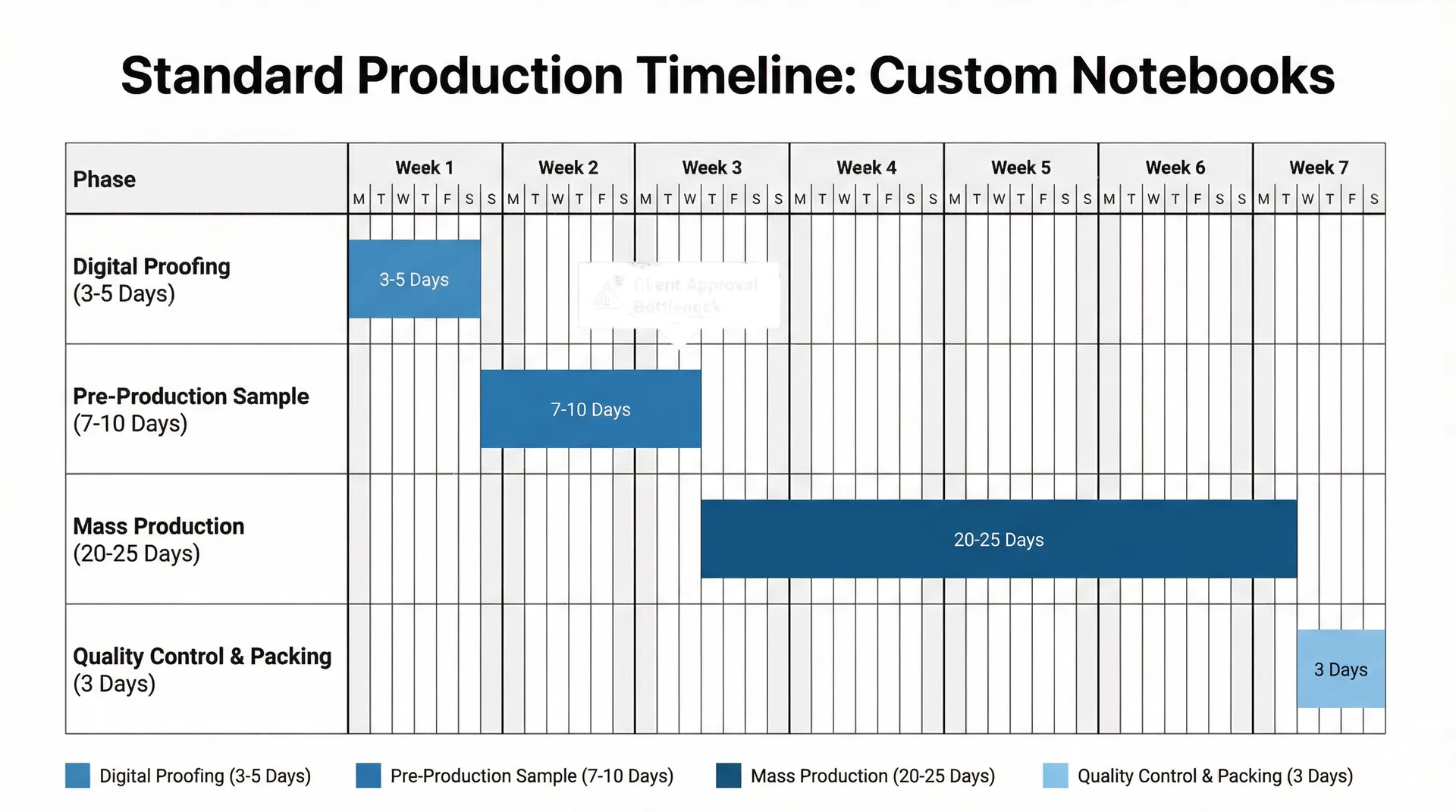
For most custom corporate stationery projects in the US market, the realistic "safe" timeline is 35-45 days from design approval to delivery. This includes 3-5 days for digital proofing, 7-10 days for pre-production sampling (critical for brand safety), 20-25 days for mass production, and 3-5 days for air freight. While "rush" options exist (15-20 days), they often require skipping the physical sample stage—a risk we rarely recommend for orders over $5,000. Key takeaway: The clock doesn't start when you pay the invoice; it starts when you approve the final proof.
Why "Lead Time" is the Most Dangerous Variable in Corporate Procurement
In our 15 years of advising Fortune 500 procurement teams, we've seen more projects fail due to unrealistic timelines than budget overruns. For a Marketing Director, a late delivery means an empty event booth. For a Procurement Manager, it means a failed vendor KPI.
The danger lies in the "Amazon Effect." We are used to 2-day retail shipping, but B2B custom manufacturing is a linear physical process that cannot be cheated without consequences.
Budget Impact: Rushing a 40-day process into 20 days often requires air freight instead of sea freight, increasing logistics costs by 300-400%. (See our guide on Freight CBM Rules).
Brand Risk: Skipping the pre-production sample to save 10 days is the #1 cause of "logo disasters"—wrong Pantone colors or poor deboss depth that can't be fixed once 5,000 units are made.
Compliance: For global enterprises, "rush" orders often bypass standard Compliance Testing, creating legal liability.
The 4 Stages of Production: A Realistic Breakdown
Many suppliers quote "Production Time" (e.g., 15 days) but conveniently omit the steps before and after. Here is the actual timeline you need to plan for.
!Standard Production Timeline Gantt ChartFigure 1: The "Hidden" phases of production. Note that the "Client Approval" phase is often the biggest bottleneck.
Phase 1: Digital Proofing & Approval (3-5 Days)
The Task: Converting your vector logo into a production-ready "mockup" that shows exact placement, size, and Pantone codes.
The Reality: This is an iterative ping-pong game. You might request a logo size adjustment, or your legal team might demand a disclaimer update.
Pro Tip: To speed this up, provide vector art (.AI or .EPS) and strict brand guidelines upfront.
Phase 2: Pre-Production Sampling (7-10 Days)
The Task: The factory makes one* perfect unit and mails it to you for physical approval.
The Trade-off: This adds ~10 days (production + shipping) but is your only insurance policy.
Decision Point: For orders under $2,000 or simple re-orders, you might approve via "Photo/Video" to save time. For new custom shapes (like a Custom Mold), physical approval is non-negotiable.
Phase 3: Mass Production (20-25 Days)
The Task: Material cutting, logo application (debossing/printing), assembly, and packing.
The Variable: This timeline assumes "standard" materials. If you require a specific Dye Lot Leather, add +15 days for the tannery to dye the hide custom for you.
Phase 4: Quality Control & Logistics (Varies Wildly)
QC: 2-3 days for internal or third-party inspection.
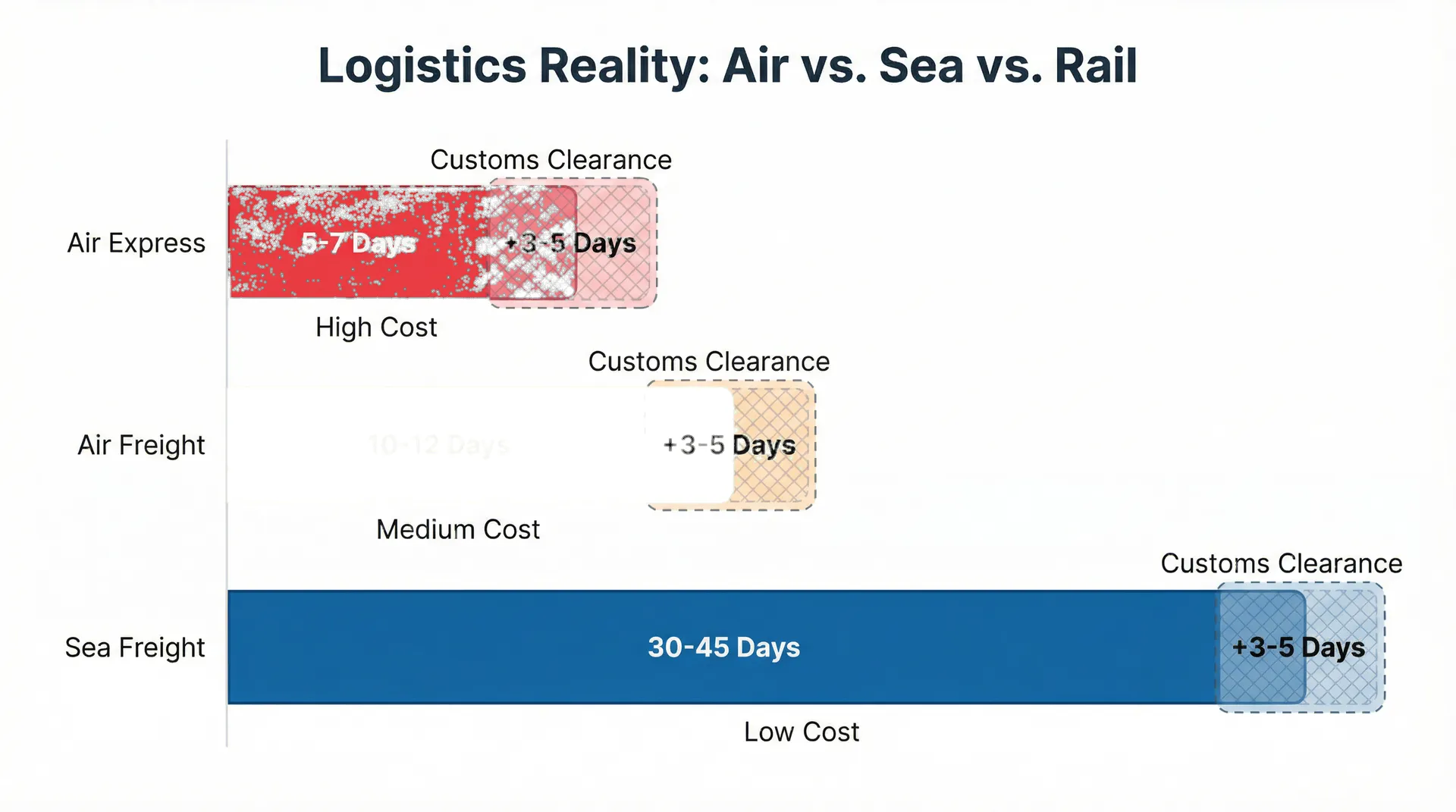
Shipping: This is where the timeline splits.
* Air Express (DHL/FedEx): 5-7 Days. Fast but expensive.
* Sea Freight: 35-45 Days. Slow but cheap.
!Logistics Reality: Air vs. Sea vs. RailFigure 2: Logistics is not just "transit time"—customs clearance adds a variable buffer to every method.
Decision Factors: What Slows You Down?
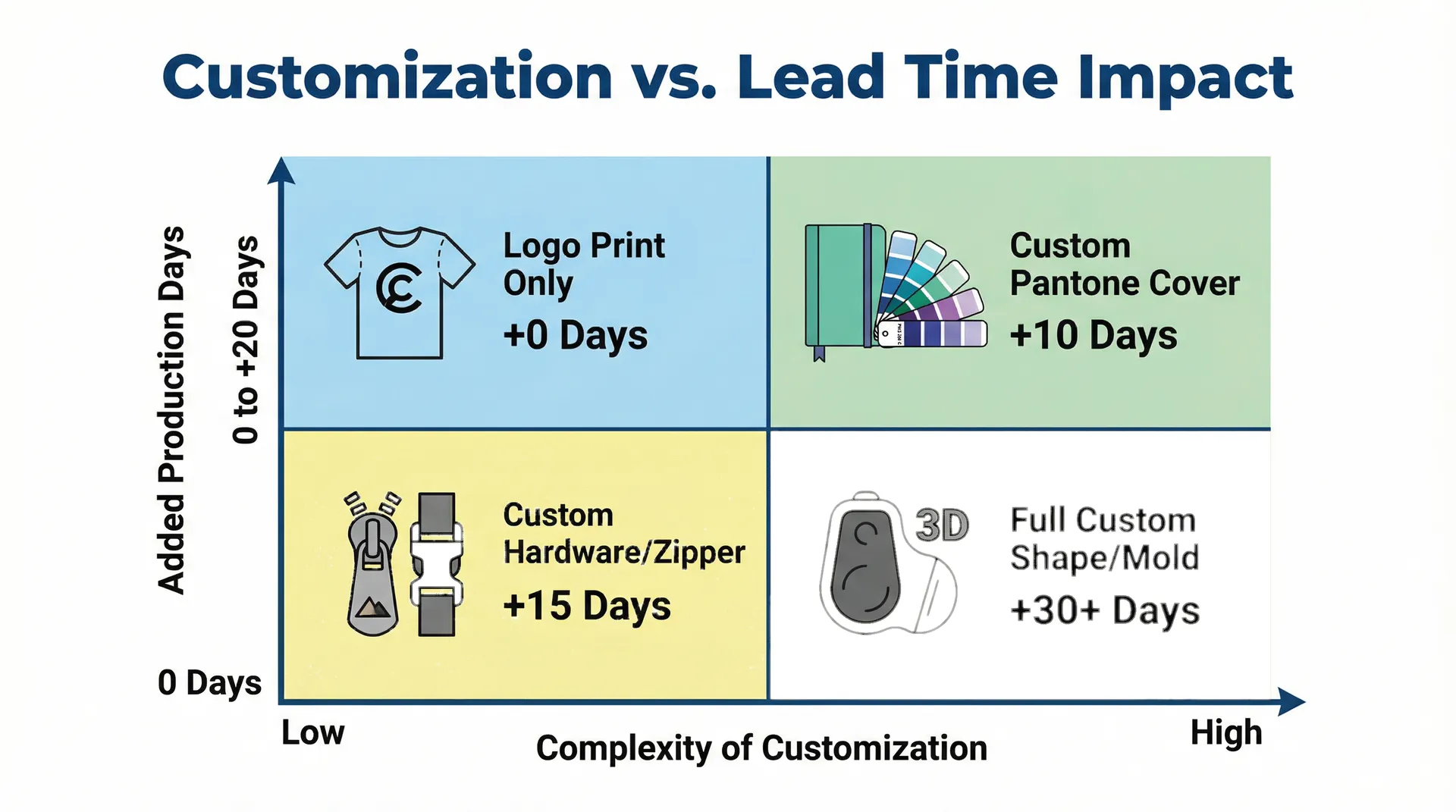
Not all customizations are created equal. A simple logo print is fast; a custom-dyed fabric is slow.
!Customization vs. Lead Time Impact MatrixFigure 3: The "Complexity Tax" on time. Moving from a standard notebook to a fully custom shape adds 30+ days.
1. Material Availability (The "Stock" vs. "Custom" Trap)
Stock Materials: (e.g., Black PU Leather, Standard 80gsm Paper) are on the shelf. Production starts immediately.
Custom Materials: (e.g., "Tiffany Blue" Leather) must be made from scratch. This triggers a Dead Stock Liability and adds 15-20 days.
2. Hardware & Components
As discussed in our Tier 2 Dictatorship article, a single custom zipper pull can force the entire factory to wait 20 days for that one part to arrive.
3. Complex Branding
Simple: Silk Screen Print (Fast, 1 day drying).
Complex:Edge Painting or Multi-layer Foil Stamping requires manual craftsmanship and longer drying times.
Strategy by Company Size
For Startups & SMEs (Speed > Perfection)
Strategy: Stick to "Stock + Logo." Choose a high-quality stock notebook in a standard color (Navy, Black, Grey) and focus your customization budget on a premium Foil Stamp or Deboss.
Benefit: Lead time is predictable (20-25 days), and MOQs are lower.
For Enterprise & Global Brands (Consistency > Speed)
Strategy: Plan 4-6 months ahead. Utilize "Split Shipments" (The Split Shipment Fallacy)—produce 10,000 units via Sea Freight for the best price, but air-ship 500 units early for an immediate event.
Benefit: You get the custom Pantone match and custom hardware without breaking the bank on air freight for the whole order.
US Market Specifics: The "Customs" Wildcard
For US clients, the biggest "hidden" delay is US Customs and Border Protection (CBP).
Section 321 (De Minimis): Orders under $800 often clear instantly.
Formal Entry (Over $2,500): Requires a Customs Bond and detailed paperwork. If your commercial invoice is vague (e.g., "Office Supplies" instead of "PU Leather Notebooks"), CBP can hold your shipment for 5-10 days for inspection.
The Fix: Ensure your supplier uses correct HS Codes and provides a detailed "Breakdown of Materials" invoice.
FAQ: Common Lead Time Questions
Q: Can I pay a "Rush Fee" to speed up production?
A: Sometimes, but money can't dry glue faster. "Rush" usually means paying for overtime labor (nights/weekends) to shave off 3-5 days. It rarely cuts production time in half without compromising quality.
Q: Why does the sample take 10 days if you already have the design?
A: The factory has to stop a mass production line, set up the machine for one unit, run it, and then reset. It's disruptive. Plus, shipping a single sample from Asia to the US takes 3-4 days alone.
Q: Does "Lead Time" include shipping?
A:Almost never. When a factory says "20 days," they mean "20 days until it sits on our loading dock." Always ask for "DDP Lead Time" (Delivered Duty Paid) to get the full picture to your door.
Q: What if I miss my event deadline?
A: We recommend a "Safety Stock" strategy. Keep 100 generic (non-dated) branded notebooks in your office closet for emergencies, so you never have to pay panic-pricing for a rush order.
Conclusion & Next Steps
Understanding the physics of production is the first step to stress-free procurement. If you treat lead time as a fixed constraint rather than a negotiable variable, you can design products that fit your timeline, rather than forcing a timeline that breaks your product.
Ready to plan your Q3/Q4 gifting strategy?
Don't wait until October. Get a Custom Quote & Timeline Analysis today, and let our team build a production schedule that hits your event date with zero drama.