Production Economics
The 'Mold Amortization' Trap: Why Custom Shapes Kill Low-Volume Economics
A Factory Project Manager explains why custom shapes require expensive steel molds and how this fixed cost makes small orders mathematically impossible.
By StationeryWorks Editorial Team, Factory Project Manager ·
In the world of custom manufacturing, few concepts are as brutally mathematical as mold amortization. As a Factory Project Manager who has overseen hundreds of product launches, I often have to deliver the hard news: that unique, custom-shaped pen clip you designed is technically possible, but economically disastrous at 500 units. This is not because the material is expensive, or because the labor is difficult. It is because of the "Tooling Trap"—the fixed cost of the steel mold that must be paid for, regardless of whether you make one unit or one million.
The Physics of the Mold
To create a custom plastic or metal part—like a uniquely shaped barrel for a promotional pen or a custom silicone grip—we must first machine a negative cavity out of hardened steel. This is the "tool" or "mold." CNC machining a high-precision steel mold takes days of machine time and skilled engineering. A simple injection mold for a pen barrel can easily cost $2,000 to $5,000. A complex multi-cavity mold for high-speed production can run upwards of $20,000. This is a fixed, upfront cost that exists before a single gram of plastic is injected.
The Math of Amortization
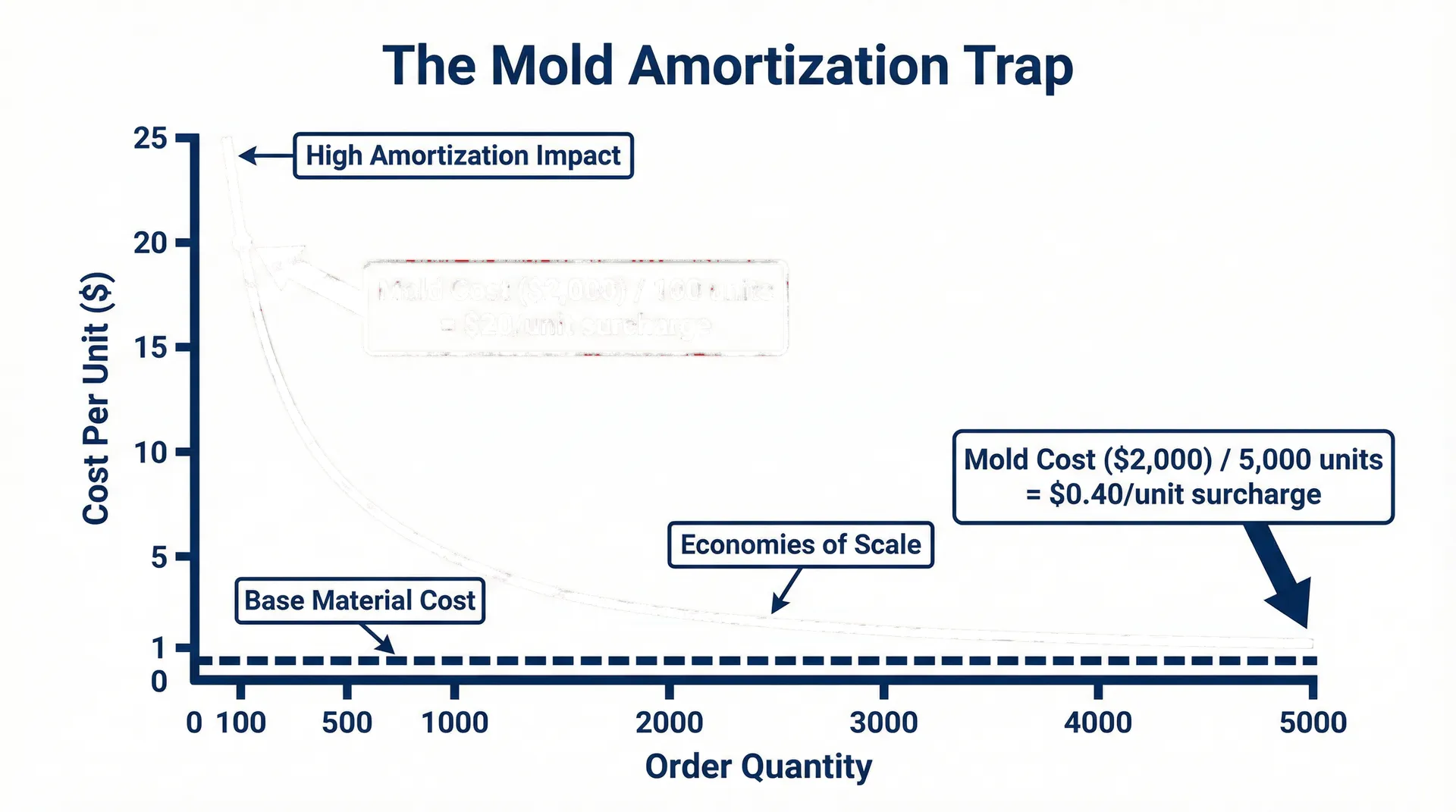
This is where the "Amortization Trap" snaps shut on low-volume orders. If your mold costs $2,000 and you order 100 units, you must add $20 ($2,000 / 100) to the cost of every single unit just to pay for the tool. If the base cost of the pen is $1.00, your final price is now $21.00 per pen. That is a 2,000% markup driven entirely by tooling.
However, if you order 10,000 units, that same $2,000 mold cost is spread much thinner. The amortization is now only $0.20 ($2,000 / 10,000) per unit. Your final price is $1.20. You are buying the exact same product, but the economics have completely shifted. This is why factories insist on high Minimum Order Quantities (MOQs) for custom shapes. It is not that we don't want to run 500 units; it is that we know you won't want to pay the unit price required to make it viable.
The "Open Mold" Alternative
When a client comes to me with a budget for 500 units but a desire for a "custom look," I steer them toward "Open Mold" components. These are parts for which the factory already owns the tooling. We have already amortized that $5,000 cost over millions of previous units. By mixing and matching open mold components—for example, taking a standard barrel shape but applying a unique custom Pantone soft-touch finish—you can achieve a unique aesthetic without triggering the tooling trap. You pay only for the unit cost and the setup of the finish, not the heavy steel of the mold itself.
Strategic Tooling Investment
There are times when paying for the mold makes sense, even for smaller brands. If you plan to reorder this product for years, you can view the mold as a capital investment (CapEx) rather than a unit cost (COGS). You pay the $5,000 upfront, and then your unit cost for all future orders remains low. This requires a long-term commitment to the design. If you change your logo or the shape next year, that mold becomes a 500-pound paperweight. In the volatile world of corporate marketing, where trends shift rapidly, locking capital into specific tooling is a risk that must be calculated carefully against the potential for long-term savings.