Supply Chain Strategy
The 'Tier 2' Dictatorship: When Component Suppliers Force Your MOQ
A Senior Procurement Consultant reveals how a single low-value component from a sub-supplier can dictate the Minimum Order Quantity for your entire product.
By StationeryWorks Editorial Team, Senior Corporate Procurement Consultant ·
As a Senior Corporate Procurement Consultant, I often see procurement teams fixate on the "Tier 1" supplier—the factory that actually assembles the final product. They negotiate hard on the assembly cost, assuming that if the factory agrees to a 500-unit order, the deal is done. But in the complex web of modern manufacturing, the Tier 1 factory is often just an assembler of parts bought from "Tier 2" suppliers. And sometimes, a single, insignificant component from a Tier 2 supplier can hold the entire production line hostage.
The Weakest Link Dictates the Chain
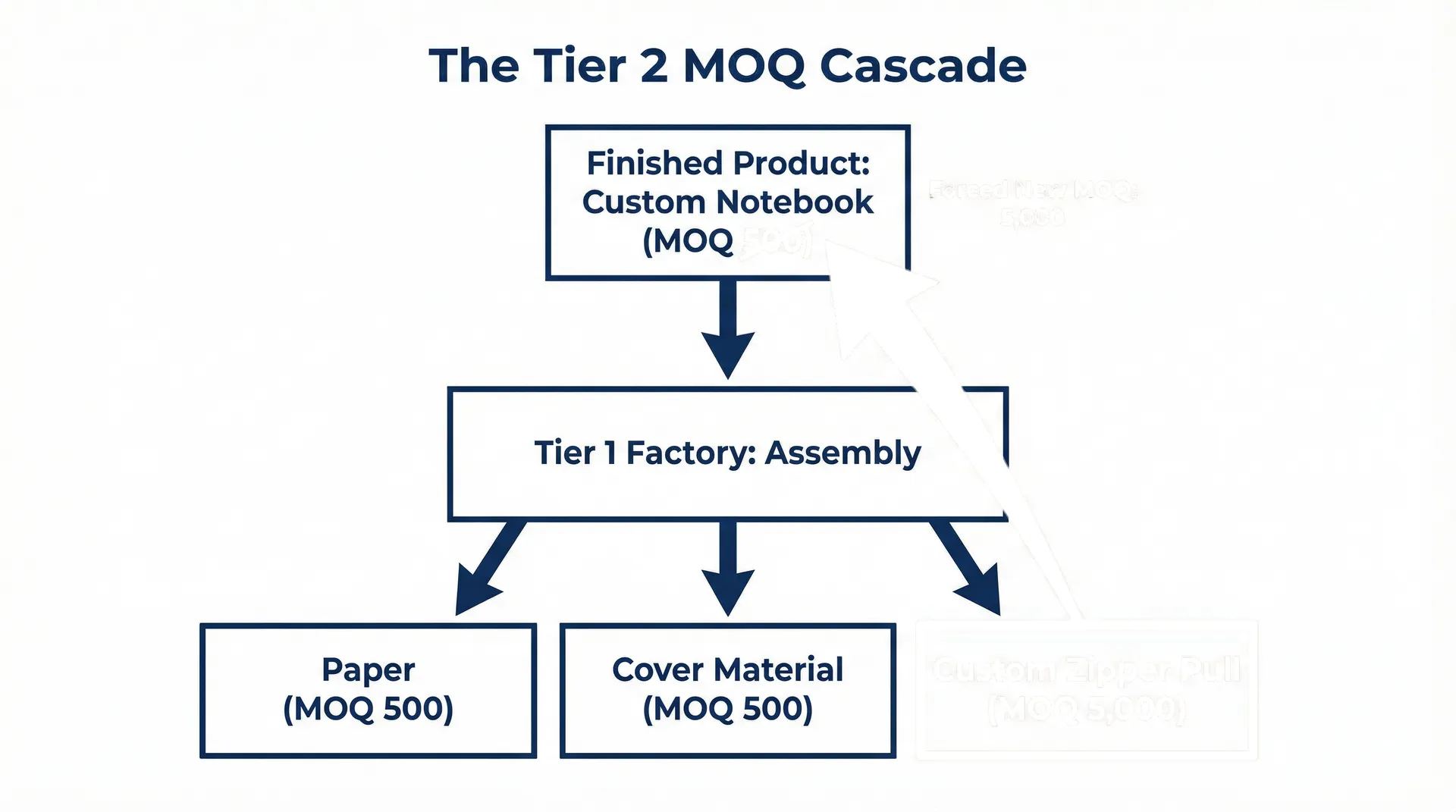
Imagine you are ordering 500 custom pencil pouches. The sewing factory (Tier 1) is happy to sew 500 units. The fabric supplier is willing to sell 500 units' worth of canvas. But then you specify a custom-molded rubber zipper pull with your logo. The zipper factory (Tier 2) has a strict policy: they will not turn on their injection molding machines for anything less than 5,000 units. Suddenly, your entire project's Minimum Order Quantity (MOQ) has jumped from 500 to 5,000, dictated solely by a $0.10 component.
This is the "Tier 2 Dictatorship." The component with the highest MOQ sets the floor for the entire finished product. It doesn't matter if 99% of the materials are available in small batches; if one essential screw, zipper, or ink refill requires a mass-production run, you are forced to either buy that volume or pay for the waste.
The "Buy and Hold" Strategy
When faced with this standoff, the most common solution is "Buy and Hold." You agree to pay for the 5,000 zipper pulls upfront, but the Tier 1 factory only uses 500 of them for your current order. They store the remaining 4,500 in their warehouse for your future orders. This allows you to keep your finished goods inventory low (500 units) while satisfying the Tier 2 supplier's demands. However, this creates a new liability: dead stock risk. If you decide to rebrand next year and change your logo, those 4,500 custom zipper pulls become worthless scrap that you have already paid for.
Designing for Supply Chain Flexibility
The smarter approach is to design with the supply chain in mind. Before finalizing a design, ask your Tier 1 supplier: "Which components have the highest MOQs?" If the custom zipper pull is the bottleneck, ask if there is a "stock" option available. Often, swapping a custom component for a standard one can drop your effective MOQ by 90%. In practice, this is often where hardware decisions start to be misjudged. Designers fall in love with a specific custom detail without realizing it is the anchor dragging down the entire project's agility.