Procurement Strategy
The 'Calendar' Illusion: Why '30 Days' Actually Means 45
Why the industry standard of quoting in 'Working Days' creates a massive disconnect with client expectations, effectively turning a '1-month' lead time into a 6-week reality.
By StationeryWorks Editorial Team, Senior Corporate Procurement Consultant ·
There is a fundamental linguistic disconnect in global supply chains. When a client hears "30 days," they think "one month." When a factory says "30 days," they mean "30 working days." This translation error is the single most common cause of missed deadlines in Q4. To a procurement professional, "30 days" is not a measure of time; it is a measure of capacity. And capacity does not exist on Sundays.
As a consultant, I often have to walk clients through the "Calendar Math" of manufacturing. A standard factory operates 6 days a week in Asia, but often 5 days a week for administrative and shipping functions. Furthermore, public holidays—Golden Week, Lunar New Year, Labor Day—are not just days off; they are production blackouts. If you receive a quote for "30 days production" on October 1st, you are not getting your goods on October 30th. You are getting them, at best, on November 15th.
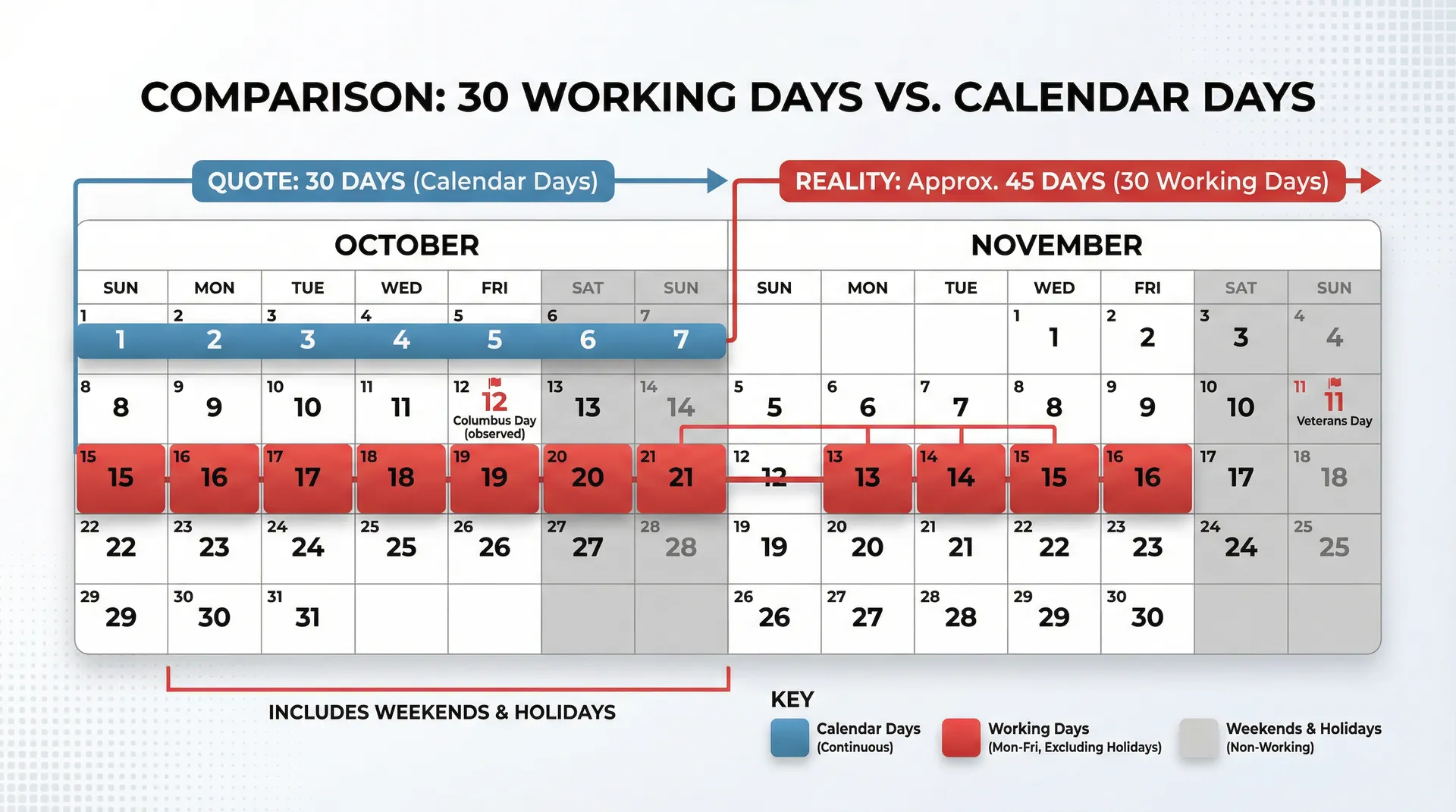
This illusion is compounded by the "buffer fallacy." Clients often add a 1-week buffer to the "30-day" quote, thinking they are safe. But if that 30-day quote is actually 45 calendar days, their 7-day buffer has already been consumed twice over before production even starts. The "30-day" lead time is a raw manufacturing metric, not a delivery promise. It excludes the 3 days for material arrival, the 2 days for pre-production sample approval, and the 5 days for booking the vessel.
In practice, this is often where lead time decisions start to be misjudged. We advise all procurement teams to convert every factory quote into a "Calendar Date" immediately. Do not accept "30 days" as an answer. Ask for an "Ex-Factory Date" (XF Date). If the factory quotes "30 days" on September 1st, ask them to confirm in writing: "So, the XF Date is October 15th?" You will often hear a hesitation. That hesitation is the sound of reality crashing into the illusion. By forcing the conversation to specific calendar dates, you strip away the ambiguity of "working days" and expose the true timeline before you sign the contract.