Logistics Strategy
The 'Consolidation Gap': Why 'Ready to Ship' Is Not 'Shipped'
Why finished goods often sit at the port for 5-7 days waiting for a container to fill up, and how missing a 'Cut-Off' time by mere hours can result in a full week's delay.
By StationeryWorks Editorial Team, Senior Logistics Consultant ·
There is a persistent linguistic misunderstanding in international logistics between the terms "Ex-Factory" (Ready to Ship) and "ETD" (Estimated Time of Departure). For a procurement manager tracking a critical order, these two dates often look synonymous. In reality, they are separated by a black hole known as the "Consolidation Gap."
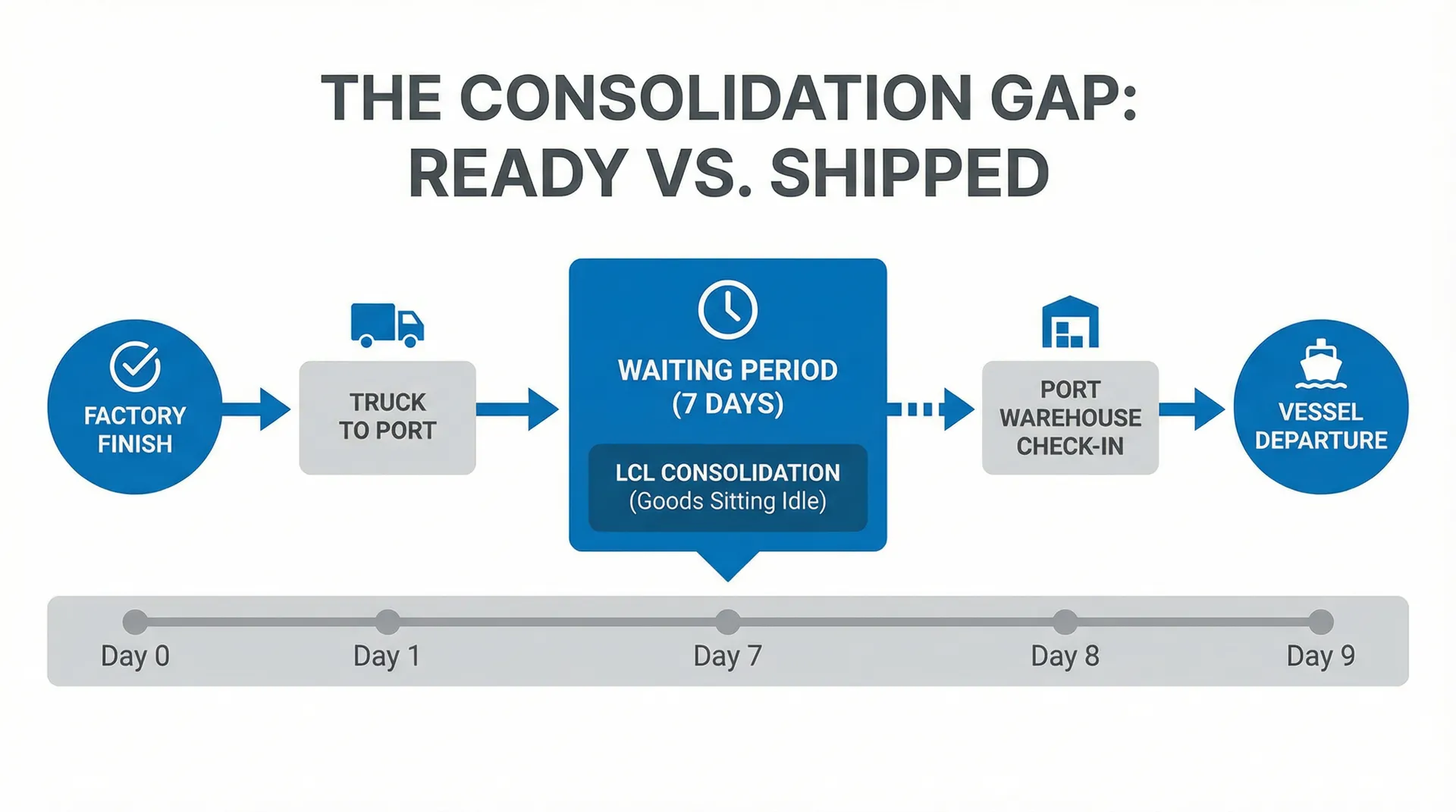
This gap exists because most corporate stationery orders—unless you are buying 50,000 notebooks at once—are shipped as LCL (Less than Container Load). Your pallets do not have the luxury of a private container; they must wait in a bonded warehouse until a freight forwarder collects enough cargo from other shippers to fill a 40-foot box. This process is not instantaneous. It is a physical Tetris game that takes time.
The "Cut-Off" Cliff
The most dangerous aspect of the Consolidation Gap is the "Cut-Off" time. Every sailing schedule has a strict deadline for cargo to be gated in at the port—usually 3 to 4 days before the vessel departs. If your production finishes on a Friday afternoon, but the cut-off for the Wednesday sailing was Friday morning, your goods will not just wait a few hours. They will miss the Wednesday ship entirely and must wait for the next week's rotation.
In practice, this means a production delay of four hours can translate into a delivery delay of seven days. This is why experienced logistics consultants never calculate lead times based on "production days" alone. They always factor in the "sailing schedule rhythm."
The "CFS" Bottleneck
Before your goods even reach the port, they must pass through a Container Freight Station (CFS). This is where the consolidation happens. Your goods are unloaded from a domestic truck, measured, weighed, and then re-loaded into the ocean container along with goods from ten other companies. This double-handling adds another layer of risk. If any of the other ten shipments in that container has customs paperwork issues, the entire container can be flagged and held. Your perfectly compliant stationery order can be held hostage by someone else's undeclared batteries.
Mitigating the Gap
To avoid falling into this gap, we recommend two strategies. First, always request the "Sailing Schedule" from your forwarder at the start of production, not the end. Work backward from the "Cut-Off" date to set your production deadline. Second, for truly urgent orders, consider "Air Freight" for a portion of the order (e.g., 10%) to bypass the consolidation process entirely, while the bulk of the order takes the slower, cheaper ocean route.
Understanding that "Ready to Ship" is merely a status update, while "Shipped" is a logistical achievement, is the first step in building a realistic timeline for your corporate projects.