Quality Assurance
The 'Curing' Constraint: Why Rush Fees Cannot Speed Up Chemistry
Why paying extra won't make glue dry faster, and how ignoring the 'resting phase' leads to warped covers and rejected shipments.
By StationeryWorks Quality Team, Quality & Compliance Consultant ·
"We have budget. Can we pay a rush fee to skip the 5-day waiting period?" This is the most common question we hear from procurement teams under pressure. The answer, unfortunately, is no. You can pay for faster shipping, and you can pay for overtime labor, but you cannot pay for faster chemistry.
The "Warping" Risk
Custom notebooks are made by gluing a paper liner to a rigid cardboard board. This introduces moisture. If you pack the notebook into a sealed polybag before this moisture evaporates (the "Curing Phase"), the moisture gets trapped. As it slowly tries to escape, it warps the cover, turning your premium gift into a curved, cheap-looking reject. This process takes 3-5 days depending on humidity.
The "Labor vs. Chemistry" Disconnect
In practice, this is often where Customization Process decisions start to be misjudged. Procurement teams view "Production Time" as a function of labor hours: "If it takes 100 hours, can we put 2 people on it and finish in 50 hours?"
For assembly, yes. For curing, no. Curing is a passive chemical process. It is like baking a cake: turning the oven up to 500°F doesn't bake it faster; it just burns the outside while the inside remains raw.
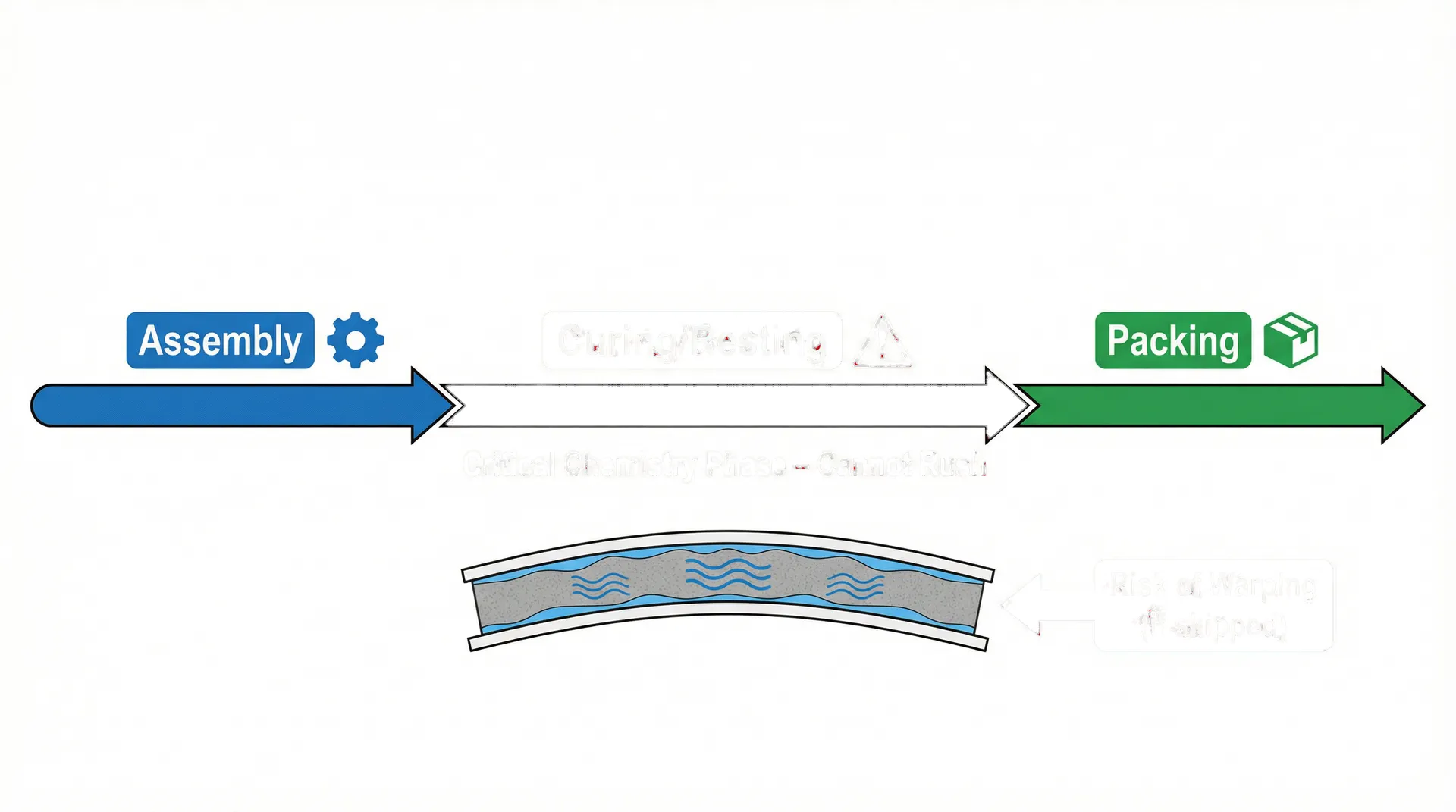
The 3 Stages of Curing
- Initial Tack (Hours 0-4): The glue holds the materials together, but is still wet. The cover feels cool to the touch.
- Moisture Evaporation (Days 1-3): The water content in the glue migrates out through the paper. This requires airflow. If you stack the books too high, the ones in the middle won't cure.
- Structural Hardening (Days 4-5): The bond becomes permanent and the board stabilizes. Only now is it safe to pack.
The "Rush Fee" Illusion
When a factory accepts a "Rush Fee" to cut 5 days off a 20-day timeline, they are usually doing one of two things:
- The Honest Way: They are prioritizing your job on the assembly line (cutting the "Queue Time").
- The Dangerous Way: They are shortening the Curing Phase. They pack the books while they are still "damp" to hit the ship date.
The Consequence: You receive the shipment on time. You open the box. The notebooks look fine. Two weeks later, sitting in your air-conditioned office, they start to curl like potato chips.
How to Manage the Curing Constraint
1. Buffer Your Timeline:
Always assume the "Production Time" quote assumes ideal weather. If it's raining in the manufacturing region (high humidity), curing takes longer. Add 3 days of buffer.
2. Ask About "Dehumidification Rooms":
Top-tier factories have climate-controlled rooms to accelerate curing safely. Ask if your factory has this capability (it costs more, but it works).
3. Never Rush the "Pack Out":
If you are desperate for time, ask the factory to ship the goods "bulk packed" (loose in cartons) rather than individually polybagged. This allows the products to continue "breathing" during transit.
Conclusion:
Quality is a function of time. In the rush to meet a deadline, do not negotiate with physics. The 5 days you save now will cost you the entire shipment later.