Procurement Strategy
The Ultimate Guide to Production Lead Times for Custom Corporate Stationery
The definitive guide to understanding, calculating, and managing lead times for custom corporate stationery. Learn why '30 days' often means 60, and how to avoid the hidden delays that derail projects.
By StationeryWorks Editorial Team, Supply Chain Consultant ·
How long does it really take to produce custom corporate stationery? If you ask a factory sales rep, they might say "30 days." If you ask a logistics forwarder, they might say "45 days." But if you ask a procurement veteran who has lived through a missed launch event, the answer is often "60 days minimum."
Expert Quick Answer
For a standard custom notebook order (1,000–5,000 units), the realistic "safe" lead time is 55–65 calendar days from deposit to door. This includes 10 days for design/approval, 15 days for material sourcing, 20 days for production, 5 days for QC, and 10 days for air freight (or 35 for sea). Warning: "30-day" quotes typically exclude weekends, holidays, and the critical "material sourcing" phase. Always plan for the "Calendar Illusion."
Why Lead Time is the #1 Risk for US Corporate Buyers
For US enterprises, lead time is not just a logistical detail; it is a strategic variable that impacts budget, brand reputation, and legal compliance. A missed delivery date doesn't just mean late notebooks; it means empty swag bags at a $500k conference, a failed employee onboarding launch, or a breach of contract with a sponsor.
Budget Impact: Rushing an order to make up for lost time is the fastest way to destroy ROI. Air freighting 5,000 notebooks costs 5x more than sea freight, often exceeding the cost of the product itself. (See our guide on Freight CBM Rules).
Brand Risk: When timelines are compressed, quality is the first casualty. Factories skip the "resting" phase for glue, leading to warped covers, or rush the logo debossing, resulting in uneven depth. (See The 'Curing' Constraint).
The 5 Phases of the Customization Process
To manage lead time, you must understand the "Waterfall" of production. It is not a single block of time, but a series of dependent events.
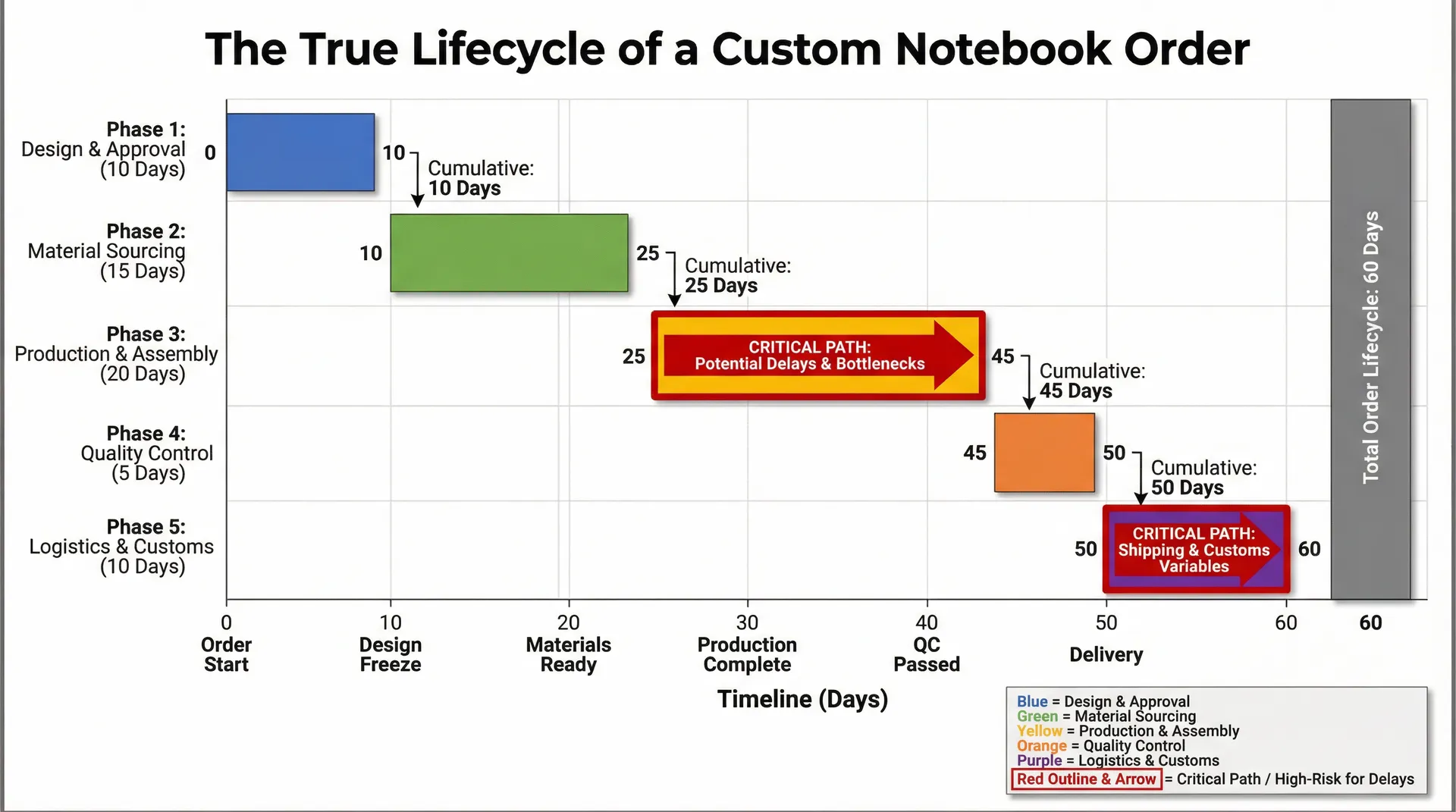
Phase 1: Design & Approval (10 Days)
This is the "invisible" phase. It includes finalizing the artwork, selecting materials, and approving the digital or physical proof. Pitfall: Clients often forget that the "clock" doesn't start until the final proof is signed and the deposit clears. (See The 'Swift' Gap).
Phase 2: Material Sourcing (15 Days)
Factories rarely hold custom materials in stock. They must order the specific PU leather, paper, and elastic band for your project. If the material is "out of stock" at the mill, this phase can double. (See The 'Phantom' Inventory).
Phase 3: Production & Assembly (20 Days)
This is the actual "making" of the product: printing, cutting, sewing, gluing, and drying. This phase is governed by physics and chemistry, not just labor. You cannot speed up glue drying time without risking quality.
Phase 4: Quality Control (5 Days)
A rigorous QC process takes time. If defects are found (e.g., 2% of covers are scratched), the factory must enter a "Remake Loop" to replace them, which can add another 10-14 days. (See The 'Remake' Loop).
Phase 5: Logistics & Customs (10-40 Days)
The final leg is the most variable. Air freight is fast (7-10 days) but expensive. Sea freight is slow (30-45 days) but cheap. Customs clearance is a binary event: it takes 2 days or 15 days, rarely in between. (See The 'Binary' Lead Time).
Critical Decision Factors: The Risk vs. Speed Trade-off
Every procurement decision involves a trade-off between Speed, Quality, and Cost. In custom manufacturing, you can usually pick two, but rarely three.
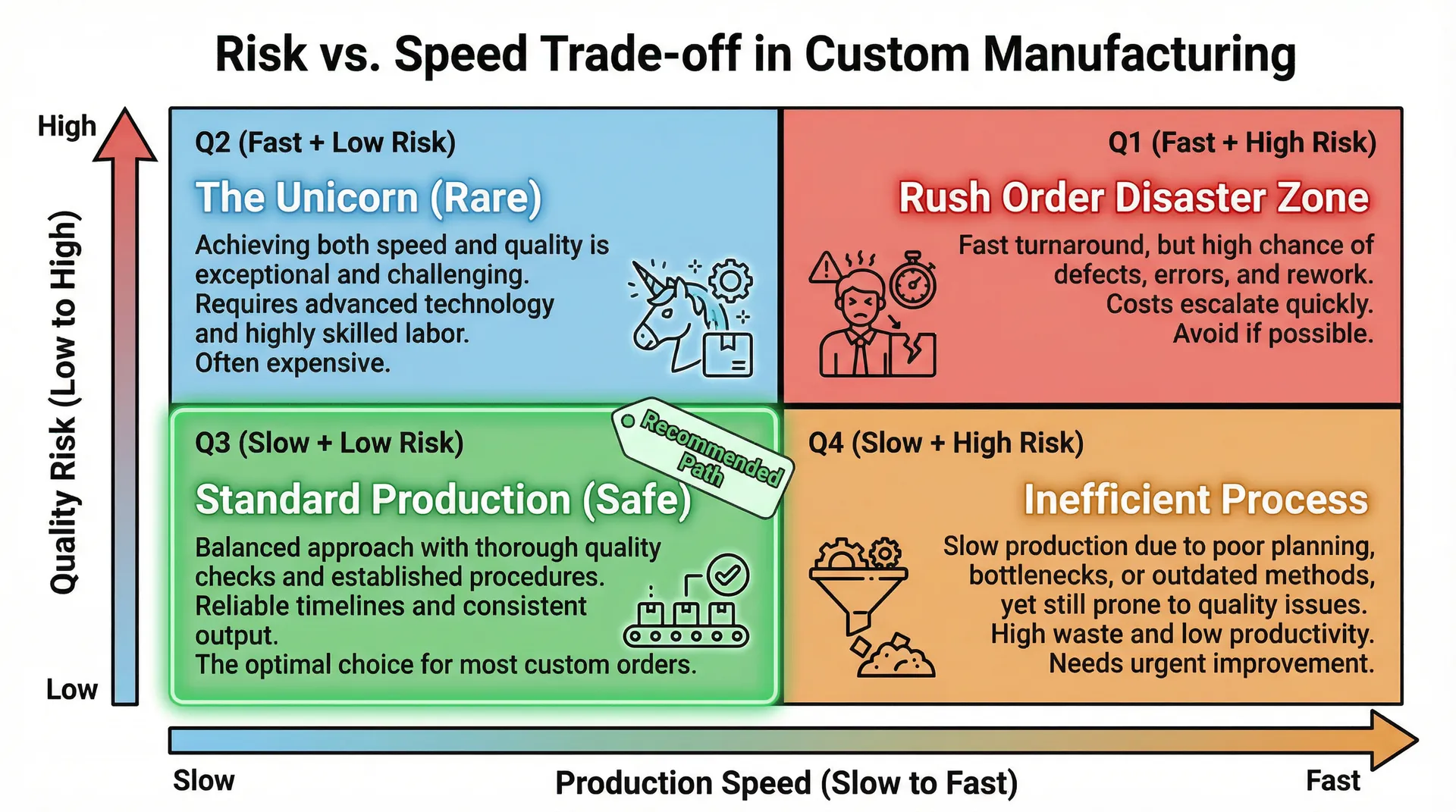
The "Rush Order" Trap (Q1): Pushing a factory to deliver in 20 days (when 30 is standard) forces them to cut corners. They might skip the QC step, use "available" (but mismatched) materials, or pack the goods while the glue is still wet. The result is often a high defect rate that ruins the project.
The "Standard" Path (Q3): This is the "Green Zone." It allows time for proper material sourcing, full curing, and 100% QC. It is the only way to guarantee the high-end finish expected by US corporate brands.
Strategy by Company Size
For Startups & SMEs
Focus: Flexibility and Low MOQ. You likely don't have the volume to demand custom material runs. Strategy: Stick to "Stock Materials" to eliminate Phase 2 (Sourcing). Accept standard colors (Black, Navy, Grey) to shave 15 days off the lead time.
For Enterprise & MNCs
Focus: Brand Consistency and Compliance. You need the exact Pantone match and certified sustainable materials. Strategy: Plan 90 days out. Use the "Split Shipment" model: air freight 10% for the launch event, and sea freight the remaining 90% to save costs. (See The 'Split Shipment' Fallacy).
Navigating the Calendar: The Hidden Blackout Dates
In the US, we worry about Christmas. In manufacturing (especially in Asia), the calendar is a minefield of "Blackout Dates" that can freeze production for weeks.
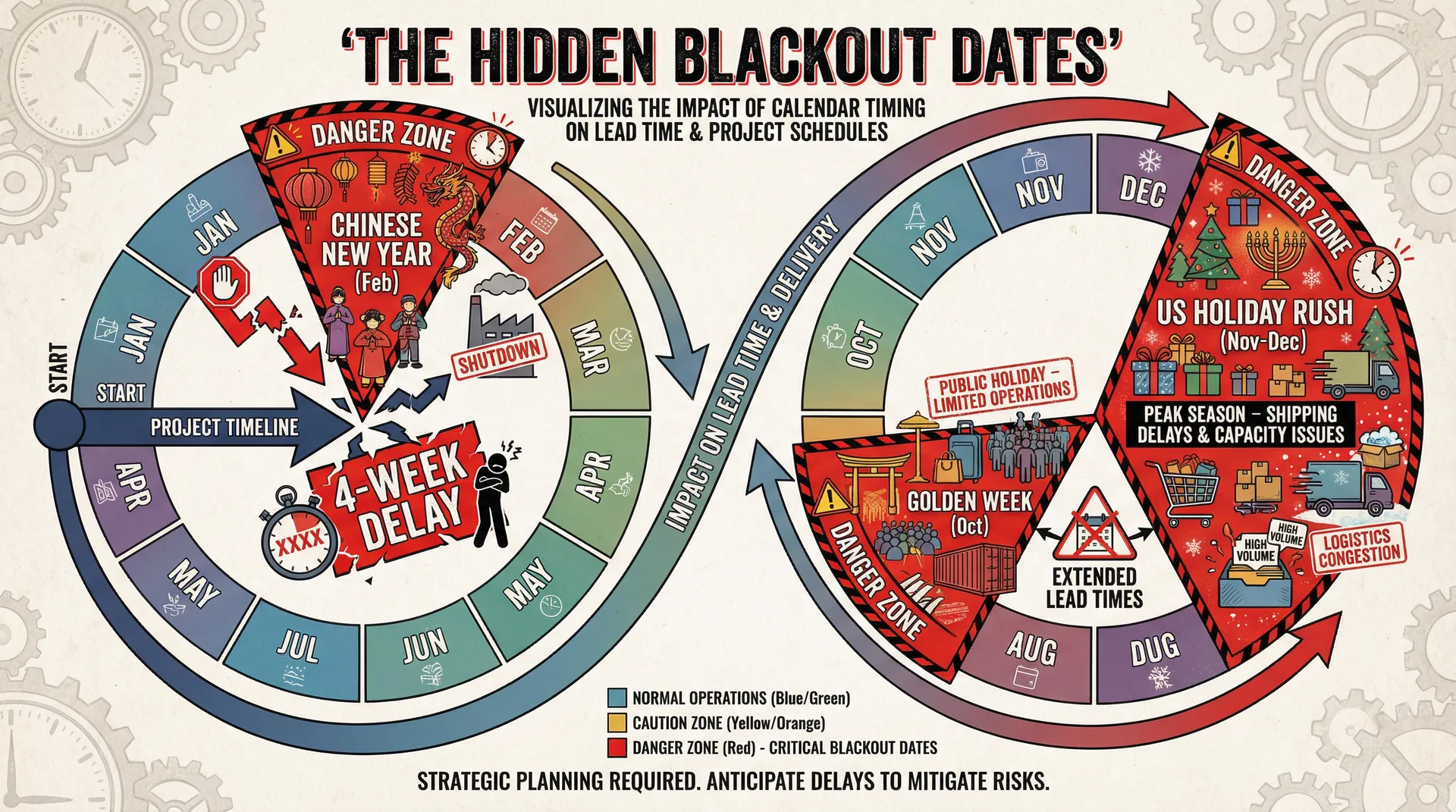
Chinese New Year (CNY): The "Super Bowl" of supply chain disruption. Factories close for 3-4 weeks in Jan/Feb. Workers leave early and return late. Rule: If your order isn't shipped by Jan 15th, it won't ship until March 1st.
Golden Week (Oct): A 1-week shutdown in early October. It creates a backlog that ripples through November, colliding with the US holiday rush.
US Holiday Rush (Nov-Dec): Ports in LA/LB become congested as retailers stock up for Black Friday. Customs exams increase. (See The 'Calendar' Illusion).
Common Questions (FAQ)
- Q: Can I pay a "Rush Fee" to speed up production?
- A: Sometimes, but be careful. You can pay for overtime labor (to speed up assembly), but you cannot pay to speed up chemistry (glue drying) or external logistics (customs). Often, a rush fee just buys you priority in the queue, not a faster process.
- Q: Why is the "sample" lead time so long (7-10 days)?
- A: Making a single sample requires the same "setup" as making 5,000 units. The machine must be calibrated, the mold created, and the material cut. It is a full production run of one. (See The FedEx Loop Fallacy).
- Q: What is the difference between "Ex-Factory" and "In-Hand" dates?
- A: "Ex-Factory" is when the goods leave the factory dock. "In-Hand" is when they arrive at your office. The gap between them is Logistics (Phase 5), which can be 5 days (Air) or 45 days (Sea). Always clarify which date you are discussing.
Conclusion: Plan for the Worst, Hope for the Best
The secret to stress-free procurement is buffer. Professional buyers never plan for the "best case" scenario. They build in a 10-day buffer for the "Phantom Inventory," the "Swift Gap," and the "Binary Customs Exam."
By understanding the true mechanics of the supply chain, you can move from "reactive chasing" to "proactive planning." Don't let a calendar date dictate your quality. Start early, account for the risks, and partner with a supplier who tells you the truth about lead times, not just what you want to hear.
Ready to start your project with a realistic timeline? Contact our team today for a detailed production schedule tailored to your deadline.