Financial Logistics
The 'Swift' Gap: Why 'Signed' Does Not Mean 'Started'
Why factories do not order raw materials when the contract is signed, but only when the deposit actually clears the bank account, creating an invisible 5-day delay.
By StationeryWorks Editorial Team, Senior Corporate Procurement Consultant ·
There is a persistent myth in corporate procurement that a signed contract is a starting gun. A buyer signs the Purchase Order (PO) on Monday, emails the PDF to the supplier, and assumes the clock has started ticking on the 30-day lead time. In reality, the clock is still frozen. For a factory operating on thin margins, a PDF is just a promise. The only thing that starts the clock is cash in the bank.
As a consultant, I call this the "Swift Gap." International wire transfers (SWIFT) are not instant; they are a relay race between correspondent banks that typically takes 3 to 5 business days. If you initiate a wire on Friday afternoon, it won't be processed until Monday, and it won't hit the supplier's account in Dongguan until Thursday. During those 6 days, your project is in limbo. The factory has not ordered the paper. They have not booked the press time. They have not even ordered the dye for the leather.
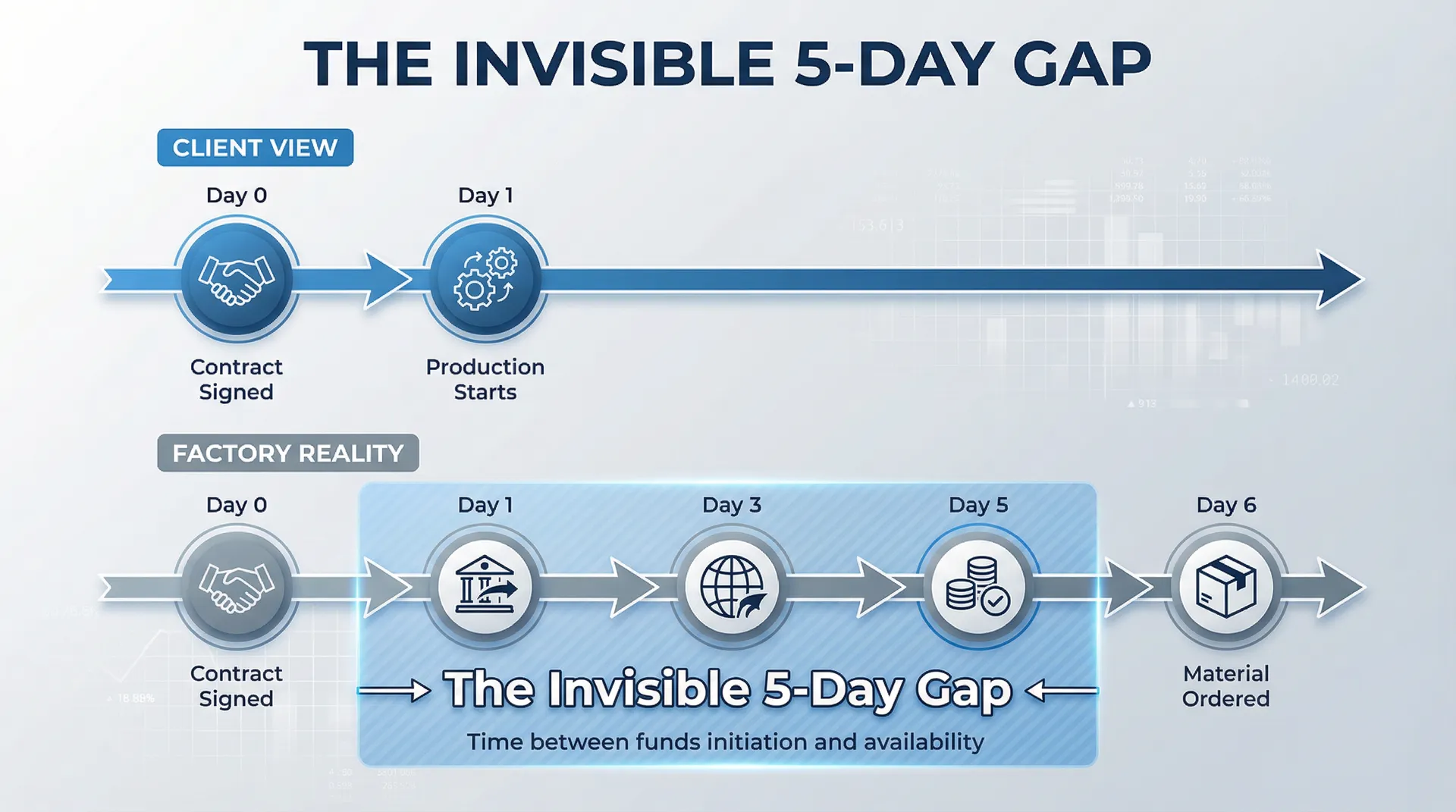
This gap is invisible to the buyer because their ERP system marks the project as "Active" the moment the PO is approved. But to the supplier, the project is "Pending Deposit." This disconnect is the primary reason why "Rush" orders fail. A client will pay a 20% premium for a rush timeline but then process the payment through a standard Net-30 cycle or a slow wire transfer, effectively neutralizing the rush fee with a payment delay.
In practice, this is often where lead time decisions start to be misjudged. To close the Swift Gap, we advise clients to send the "MT103" (the SWIFT confirmation slip) immediately upon initiating the wire. While the funds haven't cleared, a credible MT103 from a major bank is often enough for a trusted supplier to release the material order. For critical path projects, we even recommend using "same-day" payment rails or holding a "retainer" on account with the factory to bypass the banking system entirely for the initial deposit.