Material Sourcing
The 'Phantom' Inventory: Why 'In Stock' Materials Can Still Trigger a 20-Day Delay
Why having raw materials 'in stock' is useless if they belong to different dye lots that cannot be mixed, forcing a fresh production run despite the ERP showing positive inventory.
By StationeryWorks Editorial Team, Factory Project Manager ·
There is no phrase in manufacturing more dangerous than "We have it in stock." When a client hears this, they mentally deduct 20 days from the lead time. They assume the fabric is sitting on a roll, ready to be cut. But in the textile and leather world, "stock" is a quantity, not a quality. And quantity without consistency is worthless.
As a project manager, I deal with "Phantom Inventory" every week. Our ERP system might show 5,000 yards of Navy Blue PU leather in the warehouse. But physically, that 5,000 yards is split across three different production batches (dye lots). Lot A is a deep midnight blue. Lot B is slightly more purple. Lot C is a standard navy. If your order requires 4,000 yards, I cannot combine Lot A, B, and C. The color difference would be visible on the finished notebooks, creating a "patchwork" effect that no quality control team would accept.
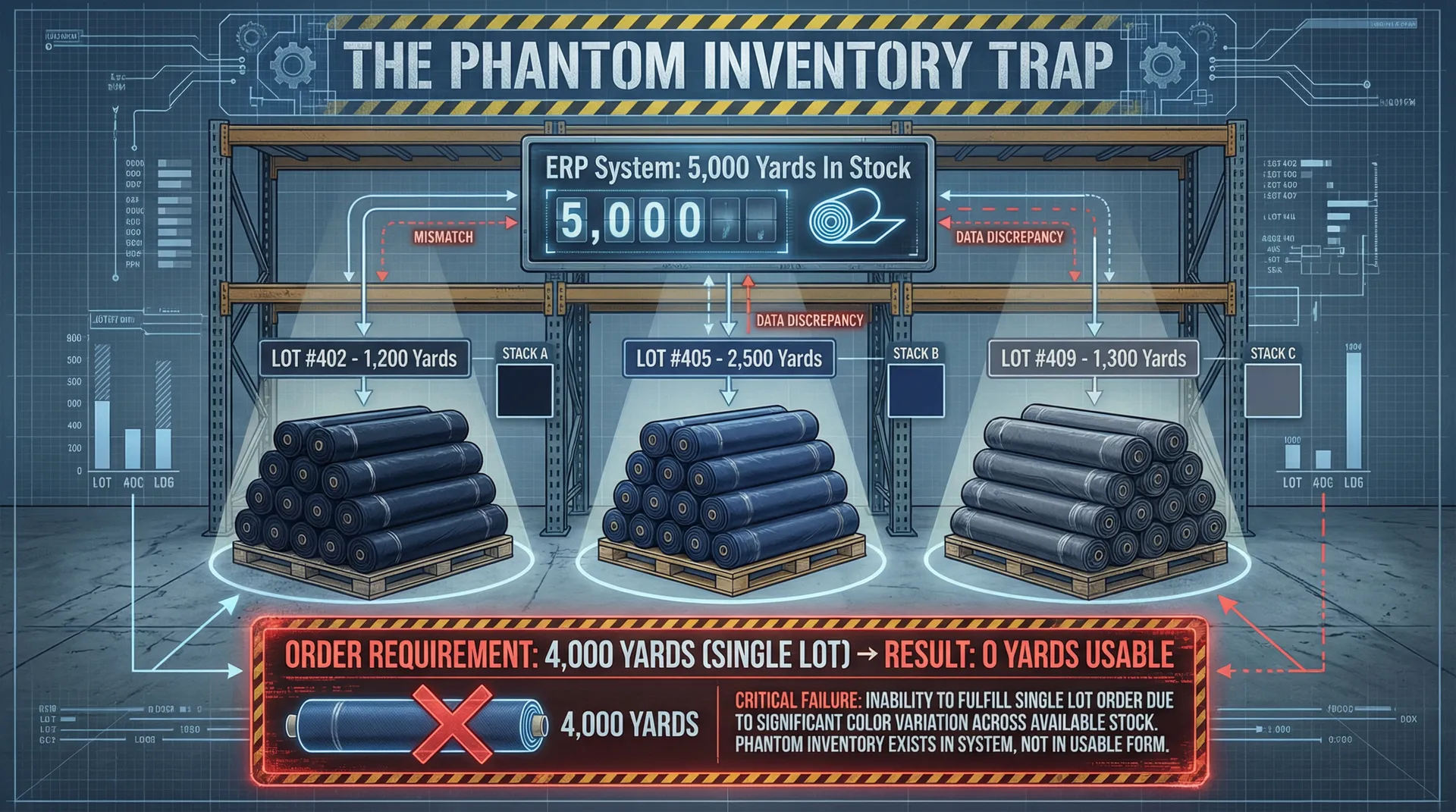
So, despite having 5,000 yards "in stock," I have zero yards usable for your specific order. I am forced to trigger a fresh production run for a new, unified dye lot of 4,000 yards. This instantly adds 20 days to the timeline—the exact 20 days you thought you saved. The inventory was a phantom: mathematically present, but operationally useless.
In practice, this is often where lead time decisions start to be misjudged. Experienced buyers don't just ask "Is it in stock?"; they ask "Is it available in a single dye lot?" If the answer is no, they either adjust their quantity to fit the largest available lot or accept the standard lead time for a fresh run. Ignoring this constraint is how "Ready to Ship" projects turn into month-long delays.