Production Management
The 'Remake' Loop: Why a 2% Defect Rate Adds 2 Weeks to Delivery
Why discovering 50 defective units in a 2,500-unit order doesn't take '2% of the time' to fix, but triggers a full production restart that can derail your entire launch.
By StationeryWorks Editorial Team, Factory Project Manager ·
In the linear logic of a spreadsheet, a 2% defect rate sounds manageable. If an order of 2,500 custom notebooks takes 20 days to produce, a procurement manager might reasonably assume that fixing 50 defective units (2%) should take roughly 0.4 days. It is a minor blip, a rounding error. On the factory floor, however, this logic collapses. Fixing 50 units does not take 4 hours; it often takes 10 days. This is the "Remake Loop," and it is the single most common reason for missed launch dates.
As a Project Manager overseeing mass production, I see this disconnect constantly. The issue is that manufacturing is not a continuous flow of identical seconds; it is a series of high-friction setups. To print those 50 replacement covers, we cannot just "squeeze them in." We must stop a machine, wash the rollers, mix the custom Pantone ink again, mount the plates, calibrate the pressure, and run the job. Then, those covers must dry (24 hours), be laminated (setup time again), be foil stamped (new die setup), and finally be bound and cured (48 hours). The volume of units has decreased by 98%, but the number of process steps—and their mandatory wait times—has remained exactly the same.
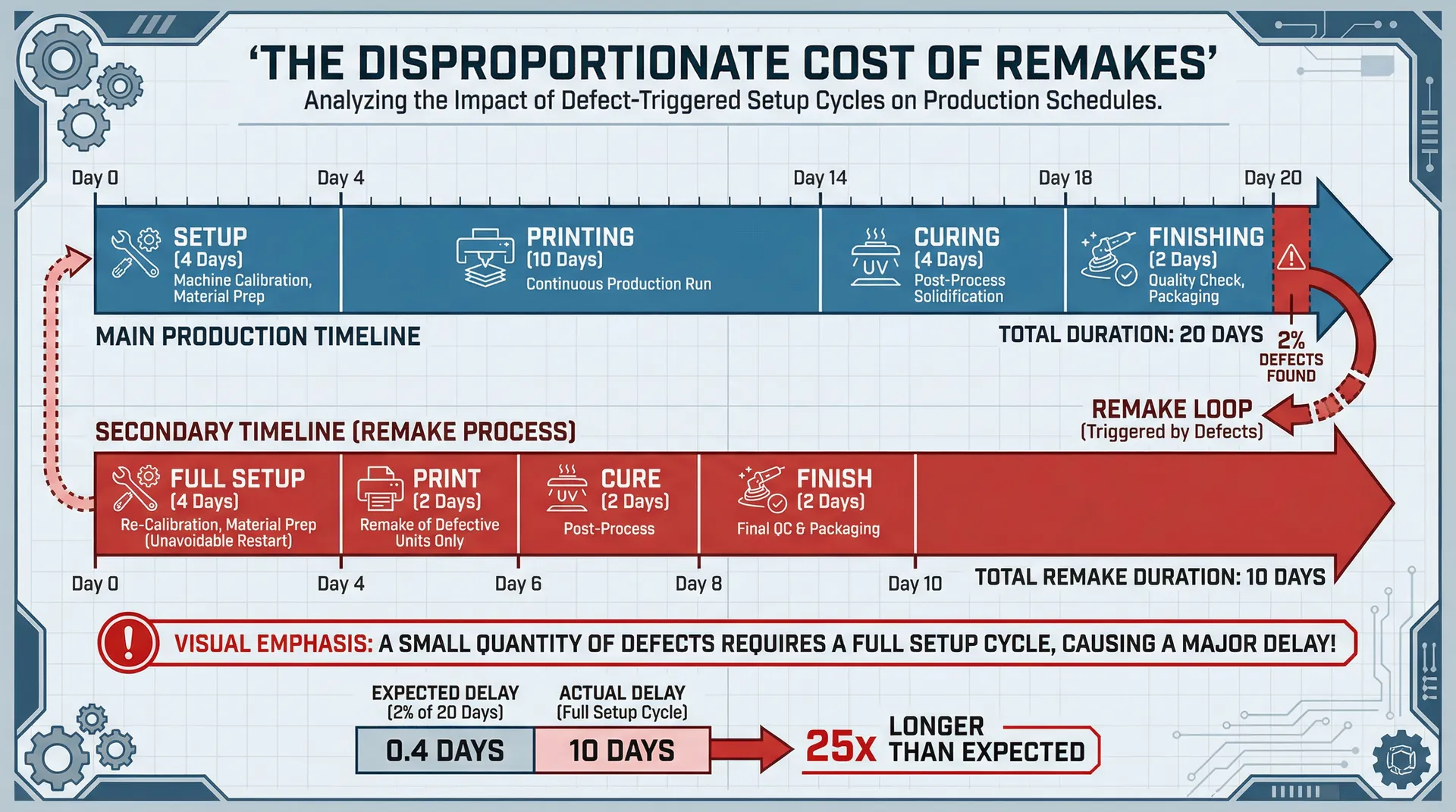
This disproportionate time penalty is why "Zero Defect" policies are dangerous if they are enforced at the very end of the line. If we wait until final inspection to catch those 50 bad units, the entire shipment is held hostage while we re-enter the production queue. The "Remake Loop" effectively resets the clock for those specific units, dragging the completion date of the whole order with it.
In practice, this is often where lead time decisions start to be misjudged. Clients often refuse "Overs" (extra units produced as a buffer) to save a few dollars. A savvy buyer does the opposite. They authorize a "Over-Run Allowance" of 3-5%. This allows us to produce 2,600 units for a 2,500 order. When 50 units fail quality control, we simply discard them and still ship 2,550 perfect units on time. We bypass the Remake Loop entirely. The cost of those extra 100 units is negligible compared to the cost of missing a hard event deadline by two weeks because we had to re-print 50 covers.