Procurement Strategy
The 'Golden Sample' Fallacy: Why Your Proof Will Never Match Production (And Why That's Good)
Why demanding 'zero variance' from a prototype is a statistical impossibility, and how to set realistic tolerance ranges for mass production.
By StationeryWorks Procurement Team, Senior Corporate Procurement Consultant ·
"This production unit is 2% darker than the proof. Reject the whole lot." I have seen this sentence destroy more quarterly budgets than any supply chain disruption. It stems from a fundamental misunderstanding of manufacturing physics: the belief that the "Golden Sample" (the proof) is the standard, rather than just one data point on a curve.
The Core Misconception
A "Golden Sample" is hand-crafted. A technician spent 20 minutes adjusting the machine for that one unit. Mass production is high-speed. The machine runs at 5,000 units per hour. It is physically impossible for the high-speed output to perfectly match the hand-tuned prototype. If your contract demands "exact match to proof," you have signed a contract for failure.
The Bell Curve of Reality
In practice, this is often where Customization Process decisions start to be misjudged. Procurement teams treat the proof as a "Target," but in reality, it is often an outlier.
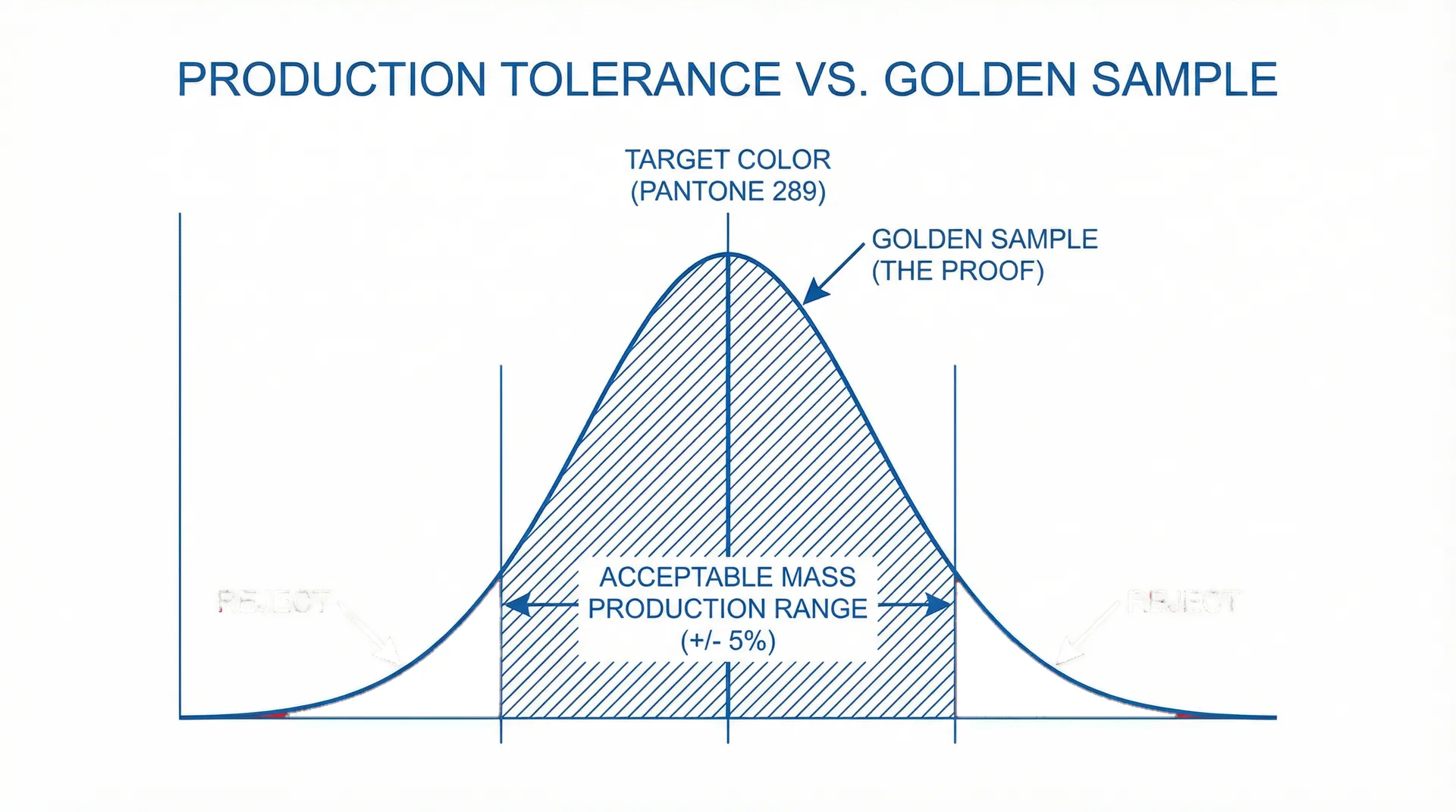
Why "Zero Tolerance" is Expensive
If you demand that every single unit matches the Golden Sample exactly (Zero Tolerance), the factory has to:
- Run the machines at 10% speed (increasing cost 10x).
- Manually inspect and discard 50% of the output (doubling material cost).
You are paying for a "Scientific Instrument" level of precision for a "Corporate Notebook." It is a misallocation of capital.
The "Range" Strategy
Smart procurement teams do not approve a "Sample." They approve a "Range."
- The Target: The Pantone color (e.g., 289C).
- The Light Limit: The lightest acceptable version.
- The Dark Limit: The darkest acceptable version.
The Solution: Ask your factory for "Limit Samples" (also called Boundary Samples). One unit that is slightly too light, one that is slightly too dark. Sign both. Now the QC team has a realistic "Go/No-Go" gauge, not an impossible ideal.
When to Be Strict (And When to Relax)
Strict Tolerance Needed:
- Logo Color: Your brand identity. (Tolerance: Delta E < 2.0)
- Fit & Finish: The lid must close. (Tolerance: +/- 0.5mm)
Relaxed Tolerance Acceptable:
- Texture Grain: Leather is natural (or simulated natural). It varies.
- Ribbon Position: Hand-glued. +/- 2mm is normal.
Conclusion:
The goal of procurement is not "Perfection," it is "Consistency within Specification." By replacing the "Golden Sample" myth with a "Tolerance Range" reality, you reduce rejection rates, lower costs, and actually get your product on time.