Production Logistics
The 'Setup Scrap' Constraint: Why 'Exact Quantity' Supply Leads to Shortages
Why providing exactly 500 notebooks for a 500-unit order guarantees you will only receive 480 finished products.
By StationeryWorks Production Team, Factory Project Manager ·
"We sent you 500 blank notebooks. Why did you only ship back 485?" This is the most common dispute we handle when clients supply their own materials. The answer lies in a machine reality that procurement teams often overlook: Setup Scrap.
The Machine Reality
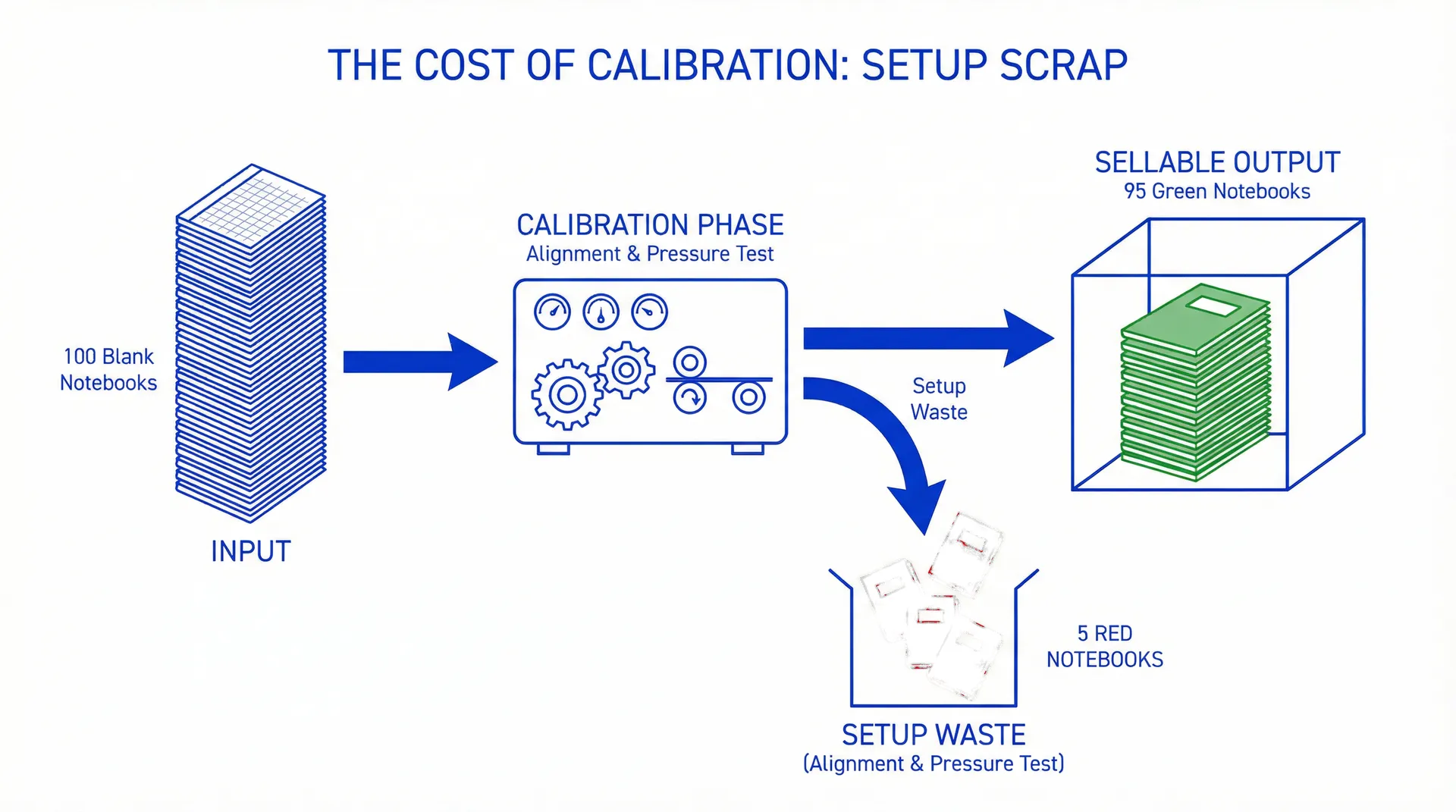
Industrial customization machines (hot foil stampers, UV printers, debossing presses) are not office laser printers. You don't just hit "Print." They require physical calibration. To align the logo perfectly in the center, we must run "test units" through the machine to adjust the pressure, heat, and position. These test units are destroyed in the process.
The "Make-Ready" Math
In practice, this is often where Customization Process decisions start to be misjudged. Clients calculate cost based on the final count, but factories calculate material needs based on the input count.
Standard Scrap Ratios
If you are supplying the goods (e.g., Moleskine notebooks you bought elsewhere), you MUST provide overage. Here is the industry standard for "Setup Scrap":
| Order Quantity | Required Overage | Why? |
|---|---|---|
| Under 100 units | +10% (min 5 units) | Calibration takes 3-5 units regardless of run size. |
| 100 - 500 units | +5% | Standard machine variance and QC checks. |
| 500+ units | +3% | Process stabilizes, but jams still happen. |
The "Exact Count" Trap
If you need exactly 500 units for an event with 500 attendees:
- Do NOT order 500.
- Order 525.
If you order 500, and we have a 3% scrap rate (which is very low), you will receive 485. You will be 15 units short. The factory cannot "make up" the difference because we don't have the raw material—you supplied it.
What Happens to the Extras?
If the run goes perfectly and we don't use all the overage, we typically:
- Ship the blanks back to you (if requested).
- Keep them as "spares" for your next order.
- Recycle them.
Conclusion:
Scrap is not a mistake; it is a part of the recipe. Just as you break eggs to make an omelet, you destroy blank notebooks to make branded ones. Plan for it, supply the overage, and you will never be short-handed at your event.