Supply Chain Strategy
The 'Sourcing Lag': Why Your Production Clock Doesn't Start When You Sign the Contract
Why the first 5-7 days of a '30-day lead time' are often spent just waiting for materials to arrive, and how to mitigate this 'invisible week'.
By StationeryWorks Editorial Team, Factory Project Manager ·
There is a fundamental disconnect between how a procurement contract defines "Day One" and how a factory production manager defines it. In a standard purchase agreement, the lead time clock typically starts ticking the moment the deposit is wired and the artwork is approved. To the client, this implies that machinery begins humming and raw materials start moving through the assembly line immediately. However, from the perspective of the factory floor, the signing of a contract does not trigger production; it triggers procurement.
For custom corporate stationery, particularly premium items involving specific leather grains or Pantone-matched papers, factories rarely hold raw inventory. Keeping rolls of Italian PU leather or specific weights of cream paper in stock is a liability, commonly referred to as "dead stock" risk. Instead, we operate on a Just-In-Time (JIT) basis. When a client signs a contract for 5,000 custom notebooks, our first action is not to turn on the printing press, but to place a purchase order with our material suppliers. This initiates the "Sourcing Lag"—a period of five to seven days where absolutely no manufacturing happens because the raw materials are still on a truck moving from a paper mill or a tannery to our warehouse.
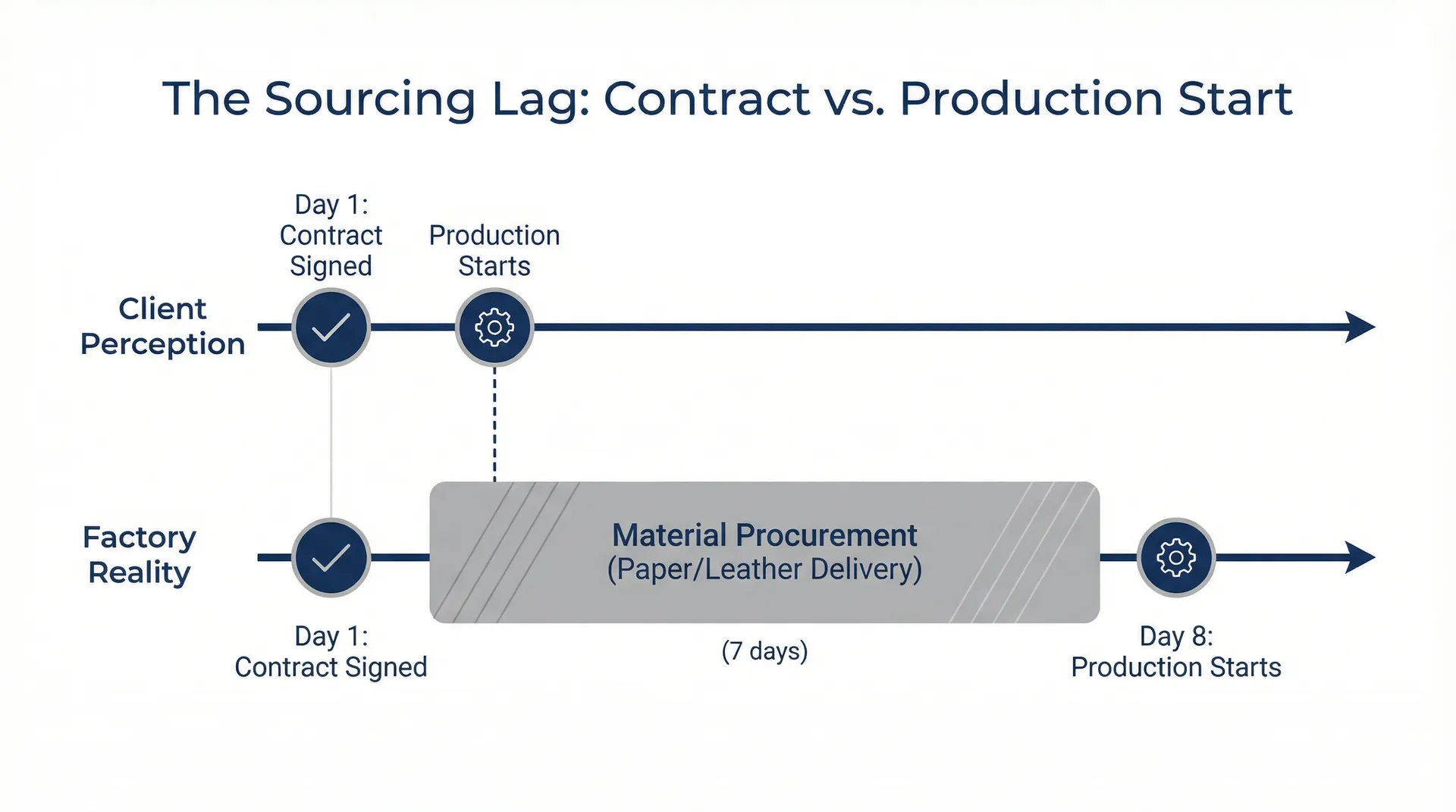
In practice, this is often where lead time decisions start to be misjudged. A procurement manager might calculate a 30-day timeline by assuming four weeks of continuous production. They fail to account for the fact that the first week is purely logistical silence. If the specific gray linen requested for the cover is out of stock at the local distributor and needs to be shipped from a regional hub, that five-day lag can easily stretch to ten. During this time, the project status remains "Pending Material," yet the delivery deadline remains fixed. This compression forces the actual production phase to run faster than optimal, increasing the risk of quality defects as glue drying times and binding curing periods are shortened to make up for the lost week.
This structural delay is why experienced supply chain managers often differentiate between "Ex-Factory Date" and "Production Start Date." They understand that the comprehensive production timeline must include this buffer. To mitigate this, savvy buyers will often authorize a "Material Deposit"—a small upfront payment specifically to secure the raw materials weeks before the final artwork is ready. This allows the factory to complete the Sourcing Lag while the design team finalizes the files, ensuring that when the "Go" signal is finally given, the materials are already sitting on the factory floor, ready to be cut.